Showing posts with label translation. Show all posts

September 19, 2009

Marcel Barang: new blog, new translations

If you are interested in Thai literature, especially translations of it, then it's a necessity to know the name of Marcel Barang. He is the world's foremost translator of Thai fiction into English and French. Not only is he prolific, but so few do what he does, making his work all the more valuable.

Today I was delighted to learn that he now keeps a blog, alternately writing in French and English, called the written wor(l)d en deux langues. It's managed to escape my attention since he began it in July, but I'm glad it didn't take me until next year to find it.

What is Marcel blogging about?

Most notably, he's completed working on a new English translation of สี่แผ่นดิน (See Phaendin) by คึกฤทธิ์ ปราโมช (Kukrit Pramoj), a former Prime Minister of Thailand. It was translated previously in 1981 under the title Four Reigns by "Tulachandra", the pen name of จันทร์แจ่ม บุนนาค (Janjaem Bunnag), who passed away in 2007, better known for her translations of Western literature into Thai.

In his must-read anthology "The Twenty Best Novels of Thailand" (1994), Marcel wrote somewhat critically of that translation:
[Tulachandra] did a creditable job of condensing the masterpiece, but spoiled it by taking upon herself the role of cultural tour guide, pepper­ing her text with mentions such as “At that time, we Thais thought that...” that are not in the original and leaving behind more than one hundred Thai words and phrases for foreign readers to memorize, I presume – from countless repetitions of the basic mai pen rai (‘never mind’) and sanuk (‘funny’) to convoluted formulas in court language.
At Marcel's primary website, thaifiction.com, you can read a lengthy excerpt from See Phaendin that he did for the same anthology, as well as many other of his translated books and stories in their entirety.

Marcel also notes in the anthology that he submitted this excerpt to Kukrit Pramoj (who passed away in 1995), but received the following reply from Kukrit's personal secretary [English translation by Marcel]:
"Judging from the sample you sent us, we think your translation is much inferior to the standard of the novel, which will destroy the quality of language and depth of Thai culture of a time when the diversity of Western cultures was not as numerous as it is today. Therefore, MR Kukrit Pramoj, the author, does not allow you to translate and publish See Phaendin."
This time around, let's hope he has the family on his side.

There are many other posts not to be missed on Marcel's blog:

"Lost in translation" -- in which Marcel reveals that his translation of Chart Korbjitti's หมาเน่าลอยน้ำ will soon be published, and that he has also translated a compilation of Chart's best short stories.

Or "The novel that doesn't exist", recounting the accidental rediscovery of a novel that neither Google nor the National Library could find.

A four part series "On literary translation from the Thai" (one, two, three, four).

And last but not least, we can expect a new-and-improved version of thaifiction.com within the month.

June 20, 2009

Thai Movie Titles: May and June 2009

As I wrote in the previous installment, "Thai titles for western films are sometimes corny, sometimes spoilery, and always entertaining. Especially when you translate them back into English. They have a style of their own."

Here are my (intentionally) over-literal re-translations of a few recent movie offerings:

Terminator Salvation: The Future Begins
ฅนเหล็ก 4 มหาสงครามจักรกลล้างโลก
"Iron Man 4: super machine war cleanses the earth"

Star Trek
สตาร์เทร็ค สงครามพิฆาตจักรวาล
"Star Trek: war to destroy the universe"

Angels and Demons
เทวากับซาตาน
"Angel and Satan"

X-Men Origins: Wolverine
เอ็กซ์ เม็น กำเนิดวูลฟ์เวอรีน
"X-Men: birth of wolverine"

The International
ฝ่าองค์กรนรกข้ามโลก
"Fighting a worldwide organization from hell"

Night at the Museum 2: Escape From the Smithsonian
มหึมาพิพิธภัณฑ์ ดับเบิ้ลมันส์ทะลุโลก
"Gigantic museum: double fun penetrates the world"

Transformers: Revenge of the Fallen
ทรานส์ฟอร์เมอร์ส : อภิมหาสงครามแค้น
"Transformers: super mega war of revenge"

March 21, 2009

Catcher in the Rye ฉบับภาษาไทย

This past Thursday, March 19, saw the launch of a new Thai translation of J.D. Salinger's best-known novel, The Catcher in the Rye. Translated by S.E.A.Write Award-winning author Prabda Yoon (ปราบดา หยุ่น), the new title is จะเป็นผู้คอยรับไว้ ไม่ให้ใครร่วงหล่น.

The new edition is published by Lighthouse Publishing (ไลต์เฮาส์พับลิชชิ่ง). The cover:


The Catcher in The Rye has twice previously been translated into Thai. Once in 1983 under the title ชั่วชีวิตของผม by "คำรวี-ใบเตย", published by สำนักพิมพ์ปิยะสาส์น, and again in 1988 under the title ทุ่งฝัน by "ศาสนิก", published by สำนักพิมพ์เรจีนา.


Covers of the 1983 and 1988 translations.


The launch was Thursday afternoon at the Siam Paragon branch of Kinokuniya. The Same Sky Books forum has photos from the event.


I plan to pick up a copy at the 37th National Book Fair next week.

[Hat tip to @Fringer, of fringer.org, who was an invited guest at the book launch.]

February 28, 2009

Translator's Corner: The Curious Case of Benjamin Button

Before the Brad Pitt movie came along and won three Oscars, "The Curious Case of Benjamin Button" was just one of F. Scott Fitzgerald's lesser known works.

As I recently noticed, it's also one of the stories translated into Thai in the (now resurrected) Wanakam.com, an excellent website put together by translator extraordinaire Marcel Barang (see also thaifiction.com).

Read "The Curious Case of Benjamin Button" in its entirety in English here or in Thai here.

Let's compare the opening paragraphs:
As long ago as 1860 it was the proper thing to be born at home. At present, so I am told, the high gods of medicine have decreed that the first cries of the young shall be uttered upon the anaesthetic air of a hospital, preferably a fashionable one. So young Mr. and Mrs. Roger Button were fifty years ahead of style when they decided, one day in the summer of 1860, that their first baby should be born in a hospital. Whether this anachronism had any bearing upon the astonishing history I am about to set down will never be known. I shall tell you what occurred, and let you judge for yourself.
สมัยเมื่อปี 1860 โน้น การเกิดที่บ้านถือเป็นเรื่องถูกต้องเหมาะสม ส่วนในสมัยนี้ ข้าพเจ้าได้ฟังมาว่าพวกเทพเบื้องสูงทางการแพทย์พากันประกาศิตว่า เด็กทารกควรจะได้เปล่งเสียงร้องครั้งแรกในท่ามกลางบรรยากาศกรุ่นยาสลบในโรง พยาบาล โดยเฉพาะโรงพยาบาลที่ทันสมัยล้ำยุค ดังนั้น สองสามีภรรยาหนุ่มสาว นายและนางโรเจอร์ บัตทอน จึงนับได้ว่ามีหัวก้าวหน้าล้ำยุคล้ำสมัยไปห้าสิบปี เพราะพวกเขาตัดสินใจในวันหนึ่งกลางฤดูร้อนปี 1860 ว่าจะคลอดบุตรคนหัวปีในโรงพยาบาล ไม่มีทางรู้ได้เลยว่าการกระทำผิดยุคผิดสมัยดังว่านี้ ส่งผลต่อเรื่องแปลกประหลาดที่ข้าพเจ้ากำลังจะเล่านี่หรือไม่ ข้าพเจ้าจะเล่าว่าเกิดอะไรขึ้น และปล่อยให้ท่านตัดสินกันเอง

Some vocabulary:

ประกาศิต / decree, command (though notice it's used as a verb here)

ล้ำยุค (or ล้ำยุคล้ำสมัย) / cutting edge, ahead of one's time

ส่งผล / to affect (here equivalent to "have bearing upon")

ผิดยุคผิดสมัย / anachronism - actually as used here it would mean "anachronistic", literally "of the wrong era". This isn't a fixed phrase in Thai, but it's a good translation, I think, given the lack of a good equivalent term. (The ศัพท์บัญญัติ equivalent from the Royal Institute is การผิดกาละ, but you won't see that outside of academic writing.)

The translation also contains some typical Thai embellishments that don't literally correspond with the English. For instance, "young Mr. and Mrs. Roger Button" is translated as สองสามีภรรยาหนุ่มสาว นายและนางโรเจอร์ บัตทอน. The phrase สองสามีภรรยาหนุ่มสาว is a stylistic mashup of atypical grammar (สอง + noun phrase, no classifier) and noun pairs (สามีภรรยา, หนุ่มสาว). These flourishes make it enjoyable to read in Thai.

So enjoy this story in the Oscar afterglow. Now I just need to get around to seeing the movie...

February 24, 2009

Thai Movie Titles: 2008 Oscar winners and nominees

Thai titles for western films are sometimes corny, sometimes spoilery, and always entertaining. Especially when you translate them back into English. They have a style of their own. Most typically, a subtitle is added to give local viewers a better idea of the content.

Have a look at some (mostly literal) translations of the Thai titles of some 2008 Academy Award winners and nominees:

Slumdog Millionaire
สลัมด็อก มิลเลี่ยนแนร์ คำตอบสุดท้ายอยู่ที่หัวใจ
"Slumdog Millionaire: the final answer is in your heart"

Revolutionary Road
ถนนแห่งฝัน สองเรานิรันดร์
"Road of Dreams: the two of us forever"

The Reader
เดอะ รีดเดอร์ ในอ้อมกอดรักไม่ลืมเลือน
"The Reader: in the embrace of unforgotten love"

The Curious Case Of Benjamin Button
เบนจามิน บัททอน อัศจรรย์ฅนโลกไม่เคยรู้
"Benjamin Button: miraculous person the world has never known"

The Dark Knight
แบทแมน อัศวินรัตติกาล
"Batman: knight of the night time"

Wall-E
หุ่นน้อยหัวใจรักษ์โลก
"Little robot whose heart saves the world"

Milk
ฮาร์วี่ย์ มิลค์ ผู้ชายฉาวโลก
"Harvey Milk: man notorious worldwide"

Doubt
เด้าท์ ปริศนาเกินคาดเดา
"Doubt: puzzle beyond guessing"

In Bruges
คู่นักฆ่าตะลุยมหานคร
"Killer duo in the big city"

February 7, 2009

Thai language added to Google Translate

I just learned that Google Translate, a machine translation tool from everyone's favorite search engine company, has added support for the Thai language, plus six more. This brings the total up to 41 languages, with the capability to translate between any two of them. You can either cut-and-paste text or feed it a URL to have it translate entire pages.

The accuracy of machine translation improves the more data Google has, usually in the form of bilingual corpora. So expect the results to be a huge grab bag for now, but also expect them to get better over time.

Notice that after you paste text to be translated, there's a link on the bottom right of the results page inviting you to "Suggest a better translation." This is great, because it harvests human knowledge to augment the machine translation.

The simple phrase ผมชื่อสมชาย returned "I named Somchai", so I suggested "My name is Somchai" instead. Piece of cake. Then I tried อภิสิทธิ์ เวชชาชีวะ (knowing it would likely translate it literally). It returned "Prerogative physician Charles existence." So I suggested "Abhisit Vejjajiva".

I've never really explored all the features of Google Translate, since I don't really know any of the languages it has hitherto supported. Exploring it now with Thai, though, they have another really cool feature: Translated Search. It's your basic cross-lanugage information retrieval. You search in your native language, specify the target language, and it returns pages in that language about the thing you searched.

For example, if you want to find Thai websites about Thai history (for, say, the images), search "Thai history", with Thai as the target language. It returns pages like the Thai Wikipedia entry on Thai history, with the first few lines in both languages. You can then click through to see the whole page translated, or view it in the original language. Quite handy.

Unfortunately, these new tools suffer from the same problem that Thai searching in regular Google does: tone marker blindness. Type ชา "tea" into Google Translate and you get "slow" (which is actually spelled ช้า), type ดิ้น "squirm" and it returns "soil" (actually ดิน), ไหม "silk" returns "burn" (actually ไหม้), and so forth. It's a problem.

Still, though, I'm really glad to see Thai on Google Translate. It can only get better with time.

January 21, 2009

Thai translation of Obama's presidential oath

This translation was quoted on more than one channel, so I'm not sure what the original source is, but I imagine it's been around for numerous presidents:

ข้าพเจ้า บารัค ฮุสเซน โอบามา ขอตั้งมั่นปฏิญาณ ว่าจะปฏิบัติหน้าที่ในตำแหน่งประธานาธิบดีสหรัฐฯ โดยเคร่งครัด และจะธำรงรักษา ปกป้อง และคุ้มครองรัฐธรรมนูญสหรัฐฯ อย่างเต็มความสามารถ ขอพระเจ้าโปรดประทานพร

And the original English:

I, Barack Hussein Obama, do solemnly swear that I will faithfully execute the office of President of the United States, and will to the best of my ability, preserve, protect, and defend the Constitution of the United States.

The actual oath varied a bit from the script. Regardless, I think it's a very nice translation.

September 4, 2008

Translator's Corner: The Great Gatsby

Preface: With the political conflict in full swing nationwide, it seems a little odd to continue posting without even acknowledging it. The fact of the matter is, it's business as usual for virtually everyone.

The price of the baht is falling, tourism is headed for the toilet, and the government is in a tight spot as the lunatics attempt to wrest control of the asylum. But even with the state of emergency declared in Bangkok and several countries issues advisories against traveling to Thailand, you could be within a couple blocks of Government House and PAD central and be none the wiser.

With that, Thai 101 continues its ongoing coverage of all things irrelevant to the political stability of the country. See
Bangkok Pundit and elsewhere for updates on that other stuff. :P


Today is two-for-one day at Thai 101. You get samples from two (count 'em) translations of that perennial favorite of high school English teachers, The Great Gatsby, by F. Scott Fitzgerald.

I read this for class in high school, and then again my freshman year of college. I enjoy me some Fitzgerald. And I have two Thai translations of
Gatsby, actually. One published in 1975 and another in 2003.

The first is titled รักเธอสุดที่รัก (literally 
I love you, my beloved), translated by ศ. ปรางค์ and published by ประพันธ์สาส์น. Based on the cover art and generous number of film stills in the front matter, it was published in connection with/to capitalize on the 1974 Robert Redford film adaptation. Here's the cover:


The second is called แกตสบี้... ผู้ยิ่งใหญ่ (literally Gatsby... the great), translated by มาศสวรรค์ จำปาสุด and published as part of a series ชุดวรรณกรรมคลาสสิกโลก 'classic world literature' by สร้างสรรค์บุ๊คส์. Its cover looks like this:


(Somewhat inexplicably, the cover designer went for what looks like a Victorian nobleman's mansion on the cover a book set in America's Roaring Twenties.)

The 1975 volume appears to have been a rush job (again, probably because it was a movie tie-in). The first ten pages are printed in mixed-up order, and quick comparison with the English reveals that the translation leaves things out here and there, including the book's final sentence. Bizarre.

But anyhow, let's look at the opening lines from The Great Gatsby in both volumes:
In my younger and more vulnerable years my father gave me some advice that I've been turning over in my mind ever since.


1975: ในวัยหนุ่มอันโชกโชนของผมนั้น พ่อผมได้ให้คำแนะนำบางสิ่งบางอย่างแก่ผมซึ่งผมยังจำได้มาจนกระทั่งทุกวันนี้


2003: คำสอนของพ่อเมื่อครั้งผมเป็นเด็ก และอ่อนต่อโลกมากกว่าตอนนี้ ยังวนเวียนอยู่ในใจผมจนถึงทุกวันนี้


"Whenever you feel like criticizing any one," he told me, "just remember that all the people in this world haven't had the advantages that you've had."


1975: พ่อบอกผมว่า "เมื่อใดก็ตามที่เธอคิดจะวิพากษ์วิจารณ์ผู้อื่นละก็ขอให้ระลึกอยู่เสมอว่าคนอื่น ๆ ในโลกนี้น่ะ ไม่มีโอกาสดีอย่างที่เธอมี"


2003: ท่านสอนไว้ว่า "เมื่อใดก็ตามที่แกรู้สึกอยากตัดสินใครสักคน ขอให้จำไว้เพียงแค่ว่า ไม่ใช่ทุกคนในโลกจะมีโอกาสทัดเทียมแก"


He didn't say any more but we've always been unusually communicative in a reserved way, and I understood that he meant a great deal more than that.

1975: ท่านไม่ได้พูดอะไรมากไปกว่านี้อีก แต่ทว่าธรรมดาเราก็พูดคุยกันไม่มากเท่าไรอยู่แล้ว และผมก็เข้าในดีอยู่ว่าท่านหมายความมากไปกว่าที่ท่านพูดออกมา

2003: พ่อไม่ได้อธิบายเพิ่มเติม แต่เรามักจะสื่อสารกันแปลก ๆ อย่างนี้แหละ คือไม่พูดอะไรมากแต่ผมเข้าใจดีว่าคำพูดของพ่อมีความหมายมากมายยิ่งกว่านั้น


In consequence I'm inclined to reserve all judgments, a habit that has opened up many curious natures to me and also made me the victim of not a few veteran bores.


1975: ด้วยเหตุนี้ผมจึงมักจะไม่ค่อยตัดสินเรื่องอะไรง่าย ๆ นี่เป็นนิสัยที่ทำให้ผมเกิดความอยากรู้อยากเห็นหลายอย่างและยังทำให้ผมกลายเป็นผู้ต้องรับเคราะห์แห่งความเบื่อหน่ายอีกด้วย


2003: สิ่งที่ตามมาคือ ผมไม่ค่อยตัดสินใคร เป็นนิสัยที่ทำให้ธรรมชาติของความเป็นคนอยากรู้อยากเห็นในตัวผมปรากฏชัดขึ้น และยังทำให้ผมตกเป็นเหยื่อของพวกที่ผ่านอะไรในชีวิตมามากอยู่หลายครั้งหลายคราด้วยกัน


The abnormal mind is quick to detect and attach itself to this quality when it appears in a normal person, and so it came about that in college I was unjustly accused of being a politician, because I was privy to the secret griefs of wild, unknown men.


1975: สมองอันผิดปกติจะค้นพบและเกาะตัวมันติดอยู่กับคุณสมบัติอันนี้ เมื่อบังเกิดขึ้นในคนปกติ ดังนั้นเมื่อสมัยที่อยู่ในมหาวิทยาลัยผมจึงถูกกล่าวหาว่าเป็นนักการเมือง เพราะผมเก็บตัวจากความยุ่งยากของคนอื่น


2003: จิตที่ไม่ปกติยึดติดกับคุณสมบัติข้อนี้ได้อย่างรวดเร็วถ้ามันเกิดขึ้นกับคนปกติ (อย่างตัวผม) เมื่อครั้งที่เรียนอยู่ในมหาวิทยาลัยผมโดนกล่าวหาว่าเป็นนักการเมือง เนื่องจากผมปิดบังความลับของกลุ่มคนที่ผมไม่รู้จัก

As I do more of these comparisons of translated texts with the originals, I must reiterate: it's hard to translate literature. In some places both translators just don't seem to quite get the author's gist, which can have far-reaching affects for an overall translation.

The story's narrator, Nick Carraway, opens the book by explaining that due to this advice his father game him, he is the (sometimes unwilling) confidante of many a person. Because he's not judgmental, people tend to spill their guts to him, like it or not.

There are a couple of lines in this opening passage that show this. First, that his neutral nature "...
made me the victim of not a few veteran bores." That is, sometimes being a good listener makes bores (i.e. boring people) talk your ear off. Also, that "...I was privy to the secret griefs of wild, unknown men". Even people he didn't know spilled their guts to him.

Neither translation quite gets these details right. I guess it's because much is not said directly, but left for the reader to infer and interpret. So while the deft and clever use of language is what makes a book like this a classic, those same touches make it diabolically difficult to render in another language.

Having done some further comparison, I prefer the 2003 to the 1975. Less literal, captures the feel of the English better. The language is a little more lively, a little more creative. And oddly, the 1975 version is missing portions of the final paragraphs of the book, I noticed. The book has a powerful ending, I think, and to see the last sentence entirely omitted from the earlier translation strikes me as odd, to say the least. I wonder if parts are missing elsewhere, too.

Vocabulary. A few words to know:
  • โชกโชน = adj. experienced, having been through a lot. Unless there's something I'm missing, this seems like the entirely wrong word for 'vulnerable' in the opening line 'in my younger and more vulnerable years'. (Also used in the sense 'drenched, soaking wet'.) So what exactly does this วัยหนุ่มอันโชกโชน mean--his young 'wild' years? Perhaps the translator was thinking vulnerable as in prone to vice? I'm not sure.
  • อยากรู้อยากเห็น = adj. curious, inquisitive.
  • คุณสมบัติ [คุน-นะ-สม-บัด] = n. characteristic, quality.
  • กล่าวหา = v. accuse.
  • เหยื่อ = n. prey, victim.
Okay, I'm all analyzed out. See you next time.


[Update: Scott of Journey to Thai pointed out that the 1974 Thai cover is designed to look just like this English movie tie-in edition published by Penguin the same year:


The Thai text is even made to look like the English. Scott also made a recent post about other similar logo designs.

Also notice that the Thai cover follows the then-standard practice of prominently featuring the translator's name, with the original author's name nowhere in sight. I think this started to change around the 1980s, but I'd have to  pretty much everything prior to that you have to look in the frontmatter to figure out who wrote the book.

The quality of a translation certainly depends on the translator's facility with language, but it's interesting that this trend has now gone the way of the dodo. Nowadays you'll virtually always have both names on the cover, author and translator.]

August 27, 2008

Translator's Corner: Romeo and Juliet

Lest you think I only ever read Thai juvenile fiction, today's installment of Translator's Corner brings us the highest of high culture: Romeo and Juliet.

The play, written in the tail end of the 16th Century, was translated by King Rama VI with the title โรเมโอและจูเลียต and first published in Thai in 1922. The copy I have is the 1978 seventh printing, a run of 1,000 copies published by สำนักพิมพ์คลังวิทยา on behalf of หอสมุดแห่งชาติ, the National Library.

King Rama VI died in 1928, which puts all of his works firmly in the public domain under Thai copyright law (which protects books for 50 years after the death of the author, or 50 years from first publication for copyrights held by an organization). Anyone who is inclined to type it up can post it to Thai Wikisource, or anywhere else for that matter.

This translation is a fantastic specimen of the writing and spelling conventions of its time. It retains liberal use of ฃ ฃวด (but ฅ คน, which died out first, isn't used).

It also uses the now-obsolete symbol ยามักการ in such names as เชกส๎เปียร์ and ลอเร็นซ๎ (above the ส and ซ, respectively--it looks at first glance like a การันต์). ยามักการ indicates that a consonant should be read as a cluster. Some modern publishers, like สำนักพิมพ์ผีเสื้อ, do continue to use it to transliterate foreign names, though.

Being as this is a translation of a play, and 80+ years old, I'm utterly unqualified to comment on the translation itself. Rather, I'm simply going to present some interesting sections and lines, corresponding to well-known passages from the original.
    Two households, both alike in dignity,
    In fair Verona, where we lay our scene,
    From ancient grudge break to new mutiny,
    Where civil blood makes civil hands unclean.
    From forth the fatal loins of these two foes
    A pair of star-cross'd lovers take their life;
    Whose misadventur'd piteous overthrows
    Doth with their death bury their parents' strife.
    The fearful passage of their death-mark'd love,
    And the continuance of their parents' rage,
    Which, but their children's end, naught could remove,
    Is now the two hours' traffic of our stage;
    The which if you with patient ears attend,
    What here shall miss, our toil shall strive to mend.

    กล่าวถึงสกุลสอง. กิติศักดิ์เสมอกัน,
       อยู่ร่วม ณ ถิ่นบรรพะบุเรศเวโรนา
    จากโทษะเก่าแก่ทุษะใหม่เกิดมา,
       จนญาติวงศาคณะมิตระผิดใจ.
    จากเบื้องอุทรโทอริแรงกำแหงไซร้
       เกิดบุตร์ชะไมในมนะรักสมัคสมาน;
    กล่าวเรื่องชะไมบุตร์ฤก็สุดจะสงสาร
       สองบุตระวายปราณและระงับกลีบร.
    เรื่องสองสมรสมรสะอีกชิวีมรณ,
       อีกสองบิดาร้อนทุษะโกรธบรู้วาย,
    จนบุตระสุดชีวิตะโกรธะจึ่งหาย,
       เปนเรื่องแสดงภาย ณ เขตสองนาฬิกา;
    หากท่านประกอบขันติสดับและทัศนา,
       ใดพร่องก็เหล่าฃ้าจะอุสาหะแก้ไข.

And some well-known lines from Act 2, Scene 2:
    O Romeo, Romeo! wherefore art thou Romeo?
    Deny thy father and refuse thy name!
    Or, if thou wilt not, be but sworn my love,
    And I'll no longer be a Capulet.

    โอ้โรเมโอ! อ้า, เธอเปนโรเมโอใย?
    ตัดขาดจากบิดา และแปลงนามเสียเปนไร
    หรือเธอยอมมิได้, ขอเพียงปฏิญญารัก,
    แล้วฃ้าจะเลิกเปนคาปุเล็ตด้วยใจภักดิ์.

...

     What's in a name? That which we call a rose
     By any other name would smell as sweet.

     นามนั้นสำคัญไฉน? ที่เราเรียกกุหลาบนั้น
     แม้เรียกว่าอย่างอื่นก็หอมรื่นอยู่เหมือนกัน;

...

     Alack, there lies more peril in thine eye
     Than twenty of their swords!

     อ้าอันตรายนั้นมีมากมวล ณ นัยนา
     ของหล่อนยิ่งกว่าดาพญี่สิบเล่ม:

...

    Good night, good night! Parting is such sweet sorrow,
    That I shall say good night till it be morrow.

     ลาก่อน, ลาก่อน! อ้า, การลานี้โศกชื่นใจ,
     จนน้องนี้อยากใคร่ร่ำลาจนอุษาสาง.

The meter manages to stay fairly close to Shakespeare's iambic pentameter, with usually 11 syllables per line.

It's a fascinating read, if somewhat more difficult than I'm accustomed to.

August 16, 2008

Translator's Corner: Encyclopedia Brown Finds the Clues

Much like 8-bit Nintendo and My Pet Monster, Encyclopedia Brown is indelibly etched into whatever section of my gray matter stores disproportionately nostalgic childhood memories.

Everyone read Encyclopedia Brown as kids, didn't they? Or was I part of yet another "special" subset of American childrendom, like town spelling bee champs and kids whose mom gave them terrible haircuts? Did I just answer my own question?

Well, anyway, I ate those books up. That and the Great Brain series. I can still picture in my mind which shelf they were located on at the public library I frequented in those heady years before the double-digits of age.

I'm surprised there haven't been any big screen adaptations of Encyclopedia Brown. Turns out in 1989 there was a ten-episode TV run on HBO, of all networks. I was even more surprised to find out that that Donald J. Sobol is still writing the series, 45 years after the first book was published. Bugs Meany is probably a repeat felon doing hard time by now.

And how exactly does that work nowadays? Is Encyclopedia forever stuck in the 60s, or is he a teenager in modern times?--"I used Google Earth and a GPS device to locate your missing keys, Mr. Johnson. Case closed. That'll be three grand. Daddy needs a new MacBook Air." (Hey, if Nancy Drew can make it to the big screen in the 21st Century, I say so can Encyclopedia Brown.)

What was I talking about again? See what I mean about disproportionately nostalgic?

The point of this post is Thai translation. Somewhere I picked up a ratty copy of Encyclopedia Brown Finds the Clues in Thai. The English was originally published in 1966, the third book in the series. The Thai translation, titled เอนไซโคลพีเดีย บราวน์ หนูน้อยยอดนักสืบ ตอนหยดสีปริศนา was published in 1994, translated by ชูศักดิ์ วิจักขณา.

A bad photograph of the cover that I bogarted 
from WeLoveBook.com (but which book?)

I'm a little disappointed at the quality of the editing, especially from ดอกหญ้า Dokya, who are typically very good. Three places in the frontmatter--two false titles pages and the title page--give the incorrect English title, Encyclopedia Brown Gets His Man, which is actually the next book in the series.

Comparing the table of contents with the English version on Amazon reveals that the book's cover is correct, and it is in fact book #3. But then, to make matters even more confusing, there are advertisements in the back for other books in the series. There's a blurb in the back for several installments of the series, including one with the same Thai title as this one, listed as coming soon. Also, typos like ต่อป instead of ต่อไป, that sort of thing.

On to the meat. Here is a chunk from the first section of the first story in this volume:
The Case of the Mysterious Tramp
คดีปล้น

His head bent low over the handlebars of his bike, Encyclopedia Brown rounded the corner of Maple Avenue like high-speed sandpaper.
เอนไซโลพีเดียก้มศีรษะลงเหนือแฮนด์รถจักรยาน เขานำรถจักรยานแล่นฉิวเลี้ยวตรงมุมถนนเมเปิล

It was three minutes before six o'clock of a summer evening.
ขณะนั้นเหลืออีก 3 นาทีจะถึงเวลา 6 โมงเย็นของวันหนึ่งในฤดูร้อน

With a bit of luck and a following wind, Encyclopedia hoped to make it home on time for dinner.
อาศัยโชคนิดหน่อยและกระแสลมที่พัดไล่หลัง เอนไซโลพีเดียหวังว่าจะไปถึงบ้านทันเวลาทานอาหารค่ำ

Suddenly someone called his name.
ทันใดนั้น ก็มีใครบางคนเรียกชื่อเขา

"Leroy! Leroy Brown!"
"เลอรอย! เลอรอย บราวน์"

Right off he knew it had to be his teacher calling.
ทราบได้ในทันทีว่าจะต้องเป็นเสียงเรียกของครูคนหนึ่ง

Only teachers and his mother and father called him Leroy.
เพราะคนที่จะเรียกว่าเลอรอยนั้น จะมีก็เพียงพ่อกับแม่และครูที่โรงเรียนเท่านั้น

Everyone else in the town of Idaville called him Encyclopedia.
ส่วนคนอื่น ๆ  ในเมืองไอดาวิลล์ เรียกเขาว่า เอนไซโลพีเดีย

He didn't look much like an encyclopedia, which is a set of books filled with all kinds of facts. Or even like one book.
เอนไซโลพีเดีย คือหนังสือสารานุกรมที่รวบรวมความรู้หลากหลายไว้ด้วยกัน อาจจะรวมเป็นชุดหลายเล่ม หรือเล่มเดียว

People called him Encyclopedia because he read more books than a bathtub full of professors.
การที่ทุกคนให้สมญานามว่า เอนไซโลพีเดียนั้น ก็เพราะว่าเขาอ่านหนังสือมากมาย

And he never forgot anything he read.
และยังสามารถจดจำเรื่องราวที่อ่านได้ทุกเรื่องไม่เคยลืม
Vocabulary. As a book aimed at young readers, there's not a ton of interesting vocabulary to point out, but here are a few:
  • แฮนด์ /hɛɛn/ = 'handlebars', presumably taken from the first syllable of that word.
  • แล่นฉิว /lɛ̂n chǐw/ - แล่น is a verb used with vehicles to indicate continual motion. Boats แล่น on the river, cars แล่น down the road. When you're stopping and starting, you're not แล่น-ing. ฉิว indicates high speed.
  • สมญานาม /sàmáyaanaam/ = This is just a fancy word for 'nickname' in this context. We might reverse-translate it as 'appellation'.
  • การที่ /kaan thîi/ = These are words everyone's familiar with, but การที่ is a compound used meaning "The fact that..." or just "That..." as in, "That everyone thinks you have bad B.O. is your own fault" (now we're moving from childhood to my early teenage years).
Transcription. I think it's odd to transcribe Leroy as เลอรอย. That sorta fits if you emphasize the last syllable, like "Luh-ROY". But the more common pronunciation in my experience is LEE-roy, which would probably be written ลีีรอย. (Not to mention that you've got the connection with that Jim Croce song "Bad, Bad Leroy Brown" reinforcing the pronunciation LEE-roy.)

Liberties with the text. The thing that strikes me the most about this excerpt is how bland the Thai is in comparison to the English. Every time the author has attempted wordplay or cleverness, the translator has scrubbed it with linguistic Scotch-Brite, so as to leave it devoid of anything remarkable or, dare I say, entertaining.

If we translate back into English, you can see how dull the Thai is:
"Encyclopedia Brown rounded the corner of Maple Avenue like high-speed sandpaper." 
becomes
"Encyclopeda sped around the corner of Maple Avenue."
The sandpaper imagery is the author trying to be original, and not resort to boring cliche. แล่นฉิว is pretty vanilla by comparison, and kind of a copout.
"People called him Encyclopedia because he read more books than a bathtub full of professors."
becomes
"People called him Encyclopedia because he read lots of books."
Did the translator take this as an affront to professors? Given that high respect is paid to teachers as a matter of mandatory ritual, this seems like a real possibility. And that's just silly. This is fiction. Not only is the flavor of the language lost, but the translator has completely downgraded Encyclopedia's genius. He's no longer a prodigy sleuth with madd reading skillz, he's now a kid who reads lots of books. Ouch.
"He didn't look much like an encyclopedia, which is a set of books filled with all kinds of facts. Or even like one book."
becomes
"An encyclopedia is a book that compiles all kinds of knowledge. They come in sets of many volumes, or in one volume."
As I addressed last time, sometimes it's hard to know what is a mistranslation and what isn't. The author is trying to be funny, and the translator has either completely missed the joke or else he's intentionally trying to suck all of the life out of this book. It's a joke, get it? He doesn't look like a set of books. He doesn't even look like one book. Because he's a human! It may be a bad joke, but so it goes. Too bad the humor nazi had to come and turn it into a lesson on the various sizes of encyclopedias.

And this is all on page one. Which, granted, is a very small sample. Maybe he was just warming up. Maybe it gets better as it goes along.

This guy translated a number of books in the series--at least four. You can find them on the cheap through the help of Google and the ragtag gang of small online Thai used book sites like Su Used Book, Sangbua, and many others. (Because I'm a compulsive book buyer, Googling the name ชูศักดิ์ วิจักขณา last night led me to purchase another couple of books he translated. I must be a glutton for punishment. Oh wait, no, I'm just compulsive.)

Would I still recommend Encyclopedia Brown in Thai? Sure. But only to someone who couldn't read the original English. Or to someone who believes wordplay and humor to be sinful indulgences. Based on this sample, this book reads like a saltine cracker.

August 9, 2008

Translator's Corner: Harry Potter and the Goblet of Fire

Today I'm trying something new. I'm going to post a sample chunk of translated literature along with commentary and criticism. About a printed page worth of text. I plan to make this a semi-regular feature, and do it in both directions--English translations of Thai books, as well as Thai translations of English books.

Now, please don't take this to mean that I believe I could do a better job translating Harry Potter, or anything for that matter. I absolutely could not. I could never even approach such a massive task. However, it is definitely worth looking at to see what we learn about translation techniques. Sometimes we'll even spot a mistake. It happens.

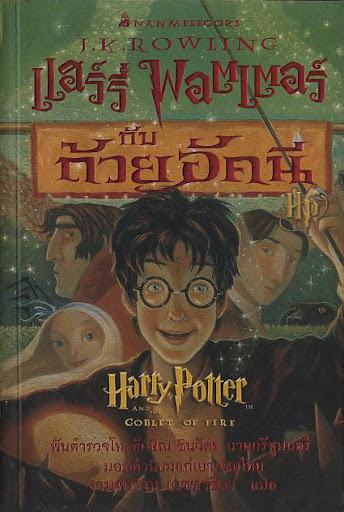
Up today is a sample from chapter 4 of Harry Potter and the Goblet of Fire, by J. K. Rowling, and its Thai translation, แฮร์รี่ พอตเตอร์ กับถ้วยอัคนี, translated by งามพรรณ เวชชาชีวะ (Ngarmpun 'Jane' Vejjajiva). Some readers may recognize the translator's name as the author of ความสุขของกะทิ 'The Happiness of Kati'. (She's also the sister of Abhisit Vejjajiva, leader of Thailand's Democrat Party.)
Mr. Weasley was looking around.
นายวีสลีย์กำลังมองไปรอบ ๆ

He loved everything to do with Muggles.
เขาชอบทุกอย่างที่เกี่ยวกับมักเกิ้ล

Harry could see him itching to go and examine the television and the video recorder.
แฮร์รี่เห็นว่าเขาอยากจะไปสำรวจดูโทรทัศน์กับเครื่องบันทึกวิดีโอจะแย่อยู่แล้ว

“They run off eckeltricity, do they?” he said knowledgeably.
“พวกนี้ใช้ไฟฝ้าใช่ไหมครับ” เขาบอกอย่างรู้ดีทั้ง ๆ ที่ใช้คำว่า ‘ไฟฟ้า’ ผิด

“Ah yes, I can see the plugs. I collect plugs,” he added to Uncle Vernon.
“ใช่แล้ว ผมเห็นปลั๊กแล้ว ผมสะสมปลั๊กไฟครับ” เขาเสริมกับลุงเวอร์นอน

“And batteries.
“แล้วก็แบตเตอรี่ด้วยครับ

Got a very large collection of batteries.
ผมน่ะมีแบตเตอรี่สะสมไว้เยอะเชียวครับ

My wife thinks I’m mad, but there you are.”
ภรรยาผมหาว่าผมสติไม่ดี แต่คุณก็มีเหมือนกันนี่ครับ”

Uncle Vernon clearly thought Mr. Weasley was mad too.
เห็นได้ชัดว่าลุงเวอร์นอนคิดว่านายวีสลีย์สติไม่ดีเช่นกัน

He moved ever so slightly to the right, screening Aunt Petunia from view, as though he thought Mr. Weasley might suddenly run at them and attack.
เขาเคลื่อนตัวไปทางขวาเล็กน้อย เอาตัวบังป้าเพ็ตทูเนียไว้ ราวกับเขาคิดว่าจู่ ๆ นายวีสลีย์อาจจะพุ่งเข้าใส่และทำร้ายเอาได้

Dudley suddenly reappeared in the room.
ทันใดนั้นเอง ดัดลีย์ก็กลับเข้ามาในห้องอีกครั้ง

Harry could hear the clunk of his trunk on the stairs, and knew that the sounds had scared Dudley out of the kitchen.
แฮร์รี่ได้ยินเสียงหีบใส่ของกระแทกขั้นบันได และรู้ว่าเสียงนั้นทำให้ดัดลีย์ตกใจและออกมาจากห้องครัว

Dudley edged along the wall, gazing at Mr. Weasley with terrified eyes, and attempted to conceal himself behind his mother and father.
ดัดลีย์เดินถัดกันแนบไปกับผนังห้อง สายตาจับจ้องอยู่ที่นายวีสลีย์และพยายามไปซ่อนตัวอยู่หลังพ่อแม่

Unfortunately, Uncle Ver­non’s bulk, while sufficient to hide bony Aunt Petunia, was nowhere near enough to conceal Dudley.
โชคร้ายที่บั้นท้ายของลุงเวอร์นอนซึ่งใหญ่พอจะบังป้าเพ็ตทูเนียที่ผอมหนังหุ้มกระดูกได้นั้น ไม่มีทางจะบดบังดัดลีย์ได้เลย

“Ah, this is your cousin, is it, Harry?” said Mr. Weasley, taking another brave stab at making conversation.
“อ้อ นี่ลูกพี่ลูกน้องจองเธอใช่ไหม แฮร์รี่” นายวีสลีย์ถาม พยายามรวบรวมความกล้าอีกระลอกที่จะเริ่มการสนทนา

“Yep,” said Harry, “that’s Dudley.”
“ครับผม” แฮร์รี่ตอบอย่างยินดี “ชื่อดัดลีย์ครับ”

He and Ron exchanged glances and then quickly looked away from each other; the temptation to burst out laughing was almost overwhelming.
แฮร์รี่กับรอนสบตากันและรีบเมินมองไปคนละทาง ความรู้สึกอยากระเบิดหัวเราะออกมานั้นรุนแรงจนแทบจะกลั้นไว้ไม่ไหวแล้ว

Dudley was still clutching his bottom as though afraid it might fall off.
ดัดลีย์ยังคงกุมก้นไว้แน่นราวกับกลัวว่ามันจะร่วงหลุดลงมา

Mr. Weasley, however, seemed genuinely concerned at Dudley’s peculiar behavior.
ทว่านายวีสลีย์ดูจะเป็นกังวลกับท่าทีพิกลของดัดลีย์อย่างจริงใจ

Indeed, from the tone of his voice when he next spoke, Harry was quite sure that Mr. Weasley thought Dudley was quite as mad as the Dursleys thought he was, except that Mr. Weasley felt sympathy rather than fear.
จริงทีเดียว เมื่อฟังจากน้ำเสียงของเขาที่พูดต่อมา แฮร์รี่แน่ใจว่านายวีสลีย์คิดว่าดัดลีย์สติไม่ดีเหมือนที่พวกเดอร์สลีย์ก็คิดว่านายวีสลีย์สติไม่ดีเหมือนกัน แต่ก็แตกต่างกันตรงที่นายวีสลีย์รู้สึกเห็นอกเห็นใจดัดลีย์มากกว่าจะนึกหวาดกลัว

“Having a good holiday, Dudley?” he said kindly.
“พักร้อนสนุกไหม ดัดลีย์” เขาถามอย่างอ่อนโยน

Dudley whimpered.
ดัดลีย์ครางหงิง

Harry saw his hands tighten still harder over his massive backside.
แฮร์รี่เห็นมือของเขาบีบบั้นท้ายอันมโหฬารแน่นขึ้นอีก

Fred and George came back into the room carrying Harry’s school trunk.
เฟร็ดกับจอร์จกลับเข้ามาในห้อง พร้อมกับยกหีบใส่ของของแฮร์รี่มาด้วย

They glanced around as they entered and spotted Dudley.
ทั้งสองกวาดตามองไปรอบห้อขณะก้าวเข้ามาและสังเกตเห็นดัดลีย์

Their faces cracked into identical evil grins.
ใบหน้าของฝาแฝดฉีกยิ้มออกมาอย่างเจ้าเล่ห์แสนกลเหมือนกันไม่มีผิดเพี้ยน

“Ah, right,” said Mr. Weasley.
“เรียบร้อย” นายวีสลีย์พูด

“Better get cracking then.”
“จุดไฟเลยดีกว่าถ้างั้น”

He pushed up the sleeves of his robes and took out his wand.
เขาถลกเขนเสื้อขึ้นและหยิบไม้กายสิทธิ์ออกม

Harry saw the Dursleys draw back against the wall as one.
แฮร์รี่เห็นครอบครัวเดอร์สลีย์ถอยกรูดไปกระจุกกันอยู่ติดผนังห้อง

Incendio!” said Mr. Weasley, pointing his wand at the hole in the wall behind him.
อินเซนดิโอ!” นายวีสลีย์ร่ายคาถา พลางชี้ไม้กายสิทธิ์ไปยังรูโหว่ที่ผนังด้านหลังเขา

Flames rose at once in the fireplace, crackling merrily as though they had been burning for hours.
เปลวไฟลุกโชติช่วงขึ้นในเตาผิงทันที มีเสียงลูกไฟแตกเปรี๊ยะอย่างร่าเริงราวกับไฟนี้จุดมานานหลายชั่วโมงแล้ว

Mr. Weasley took a small draw­string bag from his pocket, untied it, took a pinch of the powder inside, and threw it onto the flames, which turned emerald green and roared higher than ever.
นายวีสลีย์หยิบถุงหูรูดใบเล็กออกมาจากกระเป๋าเสื้อ เปิดปากถุงออกและหยิบผงในถุงออกมาหยิบมือ ก่อนจะโยนเข้าไปในกองไฟ ทำให้ไฟกลายเป็นสีเขียวมรกตและลุกโชนสูงขึ้นกว่าปกติ
There are a number of interesting things in this passage.

Vocabulary:
Here are a few words you may have learned:
  • (magic) wand = ไม้กายสิทธิ์ /máai kaay-ya-sìt/ (กายสิทธิ์, referring to an object, means to be enchanted, or to have magical properties; for example, there's an old 70s Thai movie called อัศวินดาบกายสิทธิ์ 'knight of the enchanted sword')
  • spell = คาถา /khaathǎa/
  • cast a spell = ร่ายคาถา /râai khaathǎa/ (traditionally this means to recite an incantation)
  • backside, posterior = บั้นท้าย /bân tháai/
  • drawstring bag = ถุงหูรูด /thǔŋ hǔu rûut/ (หู /hǔu/ here is the same word as 'ear', and used for things you hold onto, like หูโทรศัพท์ 'telephone receiver', หูจับ 'handle', หูถุง 'bag/sack handle(s)', etc.)
Granted, not all of it is the most useful vocabulary. But this is why it's so critical to read in Thai (or whatever language you study). It allows you to find and digest the less common vocabulary that would otherwise go over your head if you heard it in passing, or in a movie or somewhere.

Transcription: Notice where the translator chooses to use ทับศัพท์ /tháp sàp/ (transcribed words). Words like Muggle (มักเกิ้ล), proper names (แฮร์รี่, รอน, ดัดลีย์), and spell names (อินเซนดิโอ), for example. Simple transcription of proper names is pretty much a given (though not in, say, Chinese, where a little more creativity is involved). But for "Potterisms" like Muggle (an ordinary, non-magical person) or the spell names, the translator might just as well have come up with translations.

Wordplay:
There's one instance of word play in this passage (which is part of why I chose it). The character Mr. Weasley is a wizard who is obsessed with non-wizard things, like electricity. But to show how he thinks he knows more than he actually does, the author has him mispronounce 'electricity' as 'eckeltricity'. In the Thai, Mr. Weasley mispronounces the tone of the Thai word for electricity, ไฟฟ้า /fai fáa/, as ไฟฝ้า /fai fâa/.

However, an explanatory note is also given in Thai. Apparently they're worried the reader would miss the joke and think it was a typo (I'm assuming this is exactly what happened when an editor read the draft translation). The English just says "...he said knowledgeably." Its Thai equivalent translates to "...he said knowledgeably, even though he had used the word 'electricity' wrong". Wouldn't want the mispronounced version to become hip new slang! :P

Mistranslations:
Inevitably, there are things which the translator will not pick up on. Shades of meaning that native speakers pick up on. But sometimes it's hard to decide what exactly is a mistranslation.

Here's one I think is mistranslated, though:
My wife thinks I’m mad, but there you are.”
ภรรยาผมหาว่าผมสติไม่ดี แต่คุณก็มีเหมือนกันนี่ครับ”
The phrase 'but there you are' is an idiom (more of a Britishism, I'd say) that means 'but so it goes' or 'but that's just how it is'. Here she has translated it as 'but you have (a large battery collection) too.' Which doesn't make any sense at all, sense it's meant to be comical that Mr. Weasley doesn't realize most Muggles would find it strange to have a battery collection. What might have gone here instead--perhaps แต่ก็ยังงั้นแหละ or something similar.

And here's one that at first I thought was wrong, but is probably intentional:
“Better get cracking then.”
“จุดไฟเลยดีกว่าถ้างั้น”
The Thai literally means 'Better start the fire then.' (This is a method of wizard travel in the Harry Potter universe.) Of course, 'get cracking' is an English idiom meaning 'begin, begin without delay'. In this context Mr. Weasley means they should go.

At first glance I thought the translator had misunderstood 'cracking' as 'crackling', referring to the crackling flames of a fire. But after thinking about it, there's not a way to directly translate the idiom. So the translator has chosen to specify the implied action. The word เลย helps retain the meaning of 'immediately, without delay'. It seems to fit the Thai better, too.

Translation is a complex and difficult venture, to say the least. What strikes you as interesting about this text?

July 28, 2008

Chinese restaurant named TRANSLATE SERVER ERROR: Wanna open a franchise?

Ah, machine translation. This made my morning (after getting up with baby at 5am):


According to a reader comment on Boing Boing, the Chinese actually reads "dining hall" (canting, 餐厅).

Also courtesy of a clever reader comment: Don't forget to try their Short Stack Error. Or the 404 Not Pound Cakes.

I've done some proofreading for friends and such, and in a tract about animal wildlife in Thailand's national parks, I had to correct ช้างป่า translated as "wide elephants" (think about it) and "underground trees" to "undergrowth". One doesn't know whether to laugh or cry. Usually laugh.

For a virtually infinite supply of unintentional comedy, Engrish.com be to happy making you the website laugh!

[Via 2Bangkok]

February 24, 2008

Simplifed Thai spelling during World War II

I've known for a few years that Thailand experimented with simplified spelling during World War II, but I've never found much information about this little experiment. For example, what years it was in place, or just what changes were made. But nor have I looked very hard. I recall reading somewhere that the Japanese (who were occupying Thailand at the time) found Thai too complex, and wanted it simplified, but I don't know if that's the real reason. I understand that it was mandated by Field Marshal Plaek Phibunsongkhram, and even people's names had to be respelled under this system. One remnant legacy of this is that famous name in dictionaries, So Sethaputra, whose last name is spelled เสถบุตร to this day. The original spelling of his last name is เศรษฐบุตร, but since his name became famous along with his first dictionary under its revised spelling, he was one of the few that didn't revert the spelling after Field Marshal Plaek was ousted.

So imagine my delight when I discovered this grade 3 school book, copyrighted 1944. It's called แบบเรียนภาสาไทย หนังสืออ่านภูมสาตร เล่ม 1, "Thai Language Textbook: Geography Reader Book 1". Here is the cover:
The text of the cover reads:
แบบเรียนภาสาไทย
หนังสืออ่านภูมิสาตร เล่ม 1
สำหรับชั้นประถมปีที่สาม
ของ
กรมสามัญสึกสา
กะซวงสึกสาธิการ

I've marked the words with modified spellings
in red. It's interesting to see just how much of the redundancy of the Thai writing system is retained, especially when you compare it to an extreme case of simplified orthography, modern Lao. Based on reading a few pages of the text, I've observed the following changes in simplified Thai:
  • All of วรรค ฎ (i.e. ฎ ฏ ฐ ฑ ฒ ณ), the section of the alphabet corresponding to the Indic retroflex consonants, is gone, being replaced by their corresponding consonants in วรรค ด (ด ต ถ ท ธ น).
  • ใ is uniformly replaced with ไ.
  • ญ is replaced with ย in initial position (e.g. ใหญ่ > ไหย่), but retained in final position without its 'base' (ฐาน), as seen on the title page in the word สามัญ.
  • Of the three high /s/ consonants, ศ ษ ส, only ส is retained (e.g. ศึกษา > สึกสา).
  • Initial /s/ cluster ทร is replaced by ซ (e.g. กระทรวง > กะซวง).
  • The leading อ in the four words อยาก อย่า อย่าง อยู่ is replaced by ห.
  • Many consonants that don't add to the pronunciation are eliminated (e.g. จริง > จิง, ศาสตร์ > สาตร).
  • Some clusters are reduced (e.g. กระทรวง > กะซวง).
The book is divided up into 15 chapters, covering such topics as 'The Sun is a Large Ball of Fire', 'Water Becomes Steam', 'The Earth is Round' and 'Night and Day'. This seems to be a stretched definition of ภูมิสาตร 'geography', to the point that I checked a 1933 dictionary to see if the word could have been used in a broader sense meaning something like 'physical science', but not apparently not. It's just not a very good classification of the contents, since it's a language reader, after all, not a science textbook.

I've only included the image of the first page, but I've typed up chapter 1, which is three pages long. As above, simplified spellings are in red, and spellings that differ from modern spellings (but not because of this simplification) are in blue.
บทที่ 1

พระอาทิจ คือลูกไฟดวงไหย่

1 วันหนึ่งไนรึดูร้อน เด็กหลายคนนอนเล่นหยู่บนหย้าโคนต้นมะขาม วันนั้นร้อนจัดมาก จนเล่นอะไรไม่ได้ เด็กเหล่านั้นพากันบ่นต่าง ๆ นานา มีเด็กชายฝืดคนเดียวเท่านั้น ที่ชมว่าเปนเวลาเหมาะและสบายดี เพราะว่าร้อนจัดไม่ต้องทำการอะไร

2 ไนทันไดนั้น พวกเด็กได้ยินเสียงครูร้องถามมาว่า "หย่างไรนักเรียน ร้อนจัดไปหรือ จึงไม่เล่นอะไร" เด็กจึงพากันตอบว่า "ยิ่งกว่าร้อนไปเสียอีกครับ พระอาทิจนี้ช่างเหมือนไฟจิง ๆ"

3 ครูจึงว่า "ก็อะไรเสียอีกเล่า พระอาทิจก็เป็นลูกไฟน่ะซี เปนลูกไฟดวงไหย่ทีเดียว" เด็กคนหนึ่งเอ่ยขึ้นว่า "ทำไมจึงไม่มีไครเอาน้ำไปดับเสียหนอ เราจะได้ออกไปเล่นฟุตบอลล์ได้บ้าง"

4 ครูตอบว่า "ดับเสียไม่ได้ ถ้าพระอาทิจดับเราก็ตายหมด" เด็กชายฝืดจึงถามว่า "จิงหรือครับ" ครูตอบ "จิงซิ เพราะว่าความสว่าง ความร้อนและชีวิตของเรา เกิดขึ้นได้เพราะพระอาทิจ ถ้าไม่มีพระอาทิจเราก็หยู่ไม่ได้ เราจะไม่ได้รับน้ำฝน เราจะไม่เห็นละอองไอน้ำลอยขึ้นสู่ท้องฟ้า เราจะไม่เห็นน้ำไนแม่น้ำลำธารไหล ต้นไม้และสัตว์จะตายหมด น้ำจะกลายเปนน้ำแขง โลกก็จะกลายเปนก้อนน้ำแขงไหย่ และถ้าเปนดังนั้นแล้ว ฉันเชื่อว่าคงไม่มีไครชอบ เว้นเสียแต่เด็กชายฝืดคนเดียวเท่านั้น"

5 เด็กอีกคนหนึ่งกล่าวว่า "พระอาทิจคงเปนดวงไฟไหย่พิลึก หยู่ไกลเรามากนักหนา แต่ยังทำไห้เราร้อนได้" ครูว่า "ถ้าไฟไหม้โรงเรียนของเรา นักเรียนคงพากันว่าไฟไหม้ไหย่" นักเรียนทั้งหลายร้องขึ้นพร้อมกันว่า "แน่แล้วครับ" ครูจึงอธิบายว่า ถ้าไฟไหม้หมดทั้งเมือง คงไหย่กว่าไหม้โรงเรียนหลายพันเท่า แต่ถ้านักเรียนจะลองนึกไนไจว่าไฟไหม้โลกนี้ทั้งหมด และลุกโพลง ๆ โลกที่ไฟไหม้นี้ ถ้าเอาไปวางข้างพระอาทิจก็คงเล็กนิดเดียว เล็กกว่ากันตั้งล้านเท่า ถ้าพระอาทิจไหย่เท่าลูกฟุตบอลล์หรือบาตรพระ โลกเราก็จะเล็กเท่ามเล็ดถั่วเขียวเท่านั้น พระอาทิจคือดาวดวงมหึมา ที่มีแสงประกอบด้วยความร้อนพวยพุ่งแผ่รัสมีโดยรอบ และส่งรัสมีไปไนระยะไกล ๆ" นักเรียนต่างคนก็พากันประหลาดไจเปนหย่างยิ่ง

I wondered about the spelling of อาทิตย์ as อาทิจ, whether it's a result of simplified spelling or just an archaism, but pre-WWII dictionaries I have spell it as we do today, so I marked it in red. It should be noted, of course, that this is an etymologically acceptable change. The sequences ตย and จ correspond, the former indicating Sanskrit origin, and the latter Pali. There are plenty of synonym pairs like สัจ and สัตย์, for example.

This book is interesting for its content as well as its spelling. Here's my translation of the first chapter:
Chapter 1

The sun is a large ball of fire

1 One day in the hot season, a group of children were lying around on the grass beneath a tamarind tree. That day was extremely hot, to the point that they couldn't play. The children were all complaining about one thing or another. There was only one boy who was contrary, who said that this was a fitting and comfortable time, because when it is very hot you don't have to do anything.

2 Just then, the children heard their teacher's voice call out, asking, "Hello students. Why aren't you playing? Is it too hot?" The children all replied "It's more than hot. It's like the sun is fire."

3 So the teacher said, "What do you expect? The sun is a ball of fire. It is a very large ball of fire." One child said, "Why doesn't someone take water and put it out. That way we could play some football."

4 The teacher answered, "You can't put it out. If you put the sun out, we would all die." Then the contrary boy asked, "Really?" The teacher answered, "Yes, really. Because light, heat and our lives can all exist because of the sun. If we didn't have the sun, we couldn't live. We wouldn't have rain. We wouldn't see steam floating up to the sky. We wouldn't see water in rivers and streams flow. The trees and animals would all die. Water would become ice. The world would become a large ball of ice. And if it were like that, I think no one would like it, except for one contrary boy."

5 Another child said, "The sun is a strange big ball of fire. It's very far from us, but it can still make us hot." The teacher said, "If our school burned down, you students would probably say it was a big fire." The students cried out together, "Of course!" The teacher then explained that if the whole city burned, it would be larger than the school fire many thousands of times over. But if the students would imagine that the whole world burned, and burned very bright, if you took this burning world and placed it next to the sun, it would be very small. A million times smaller. If the sun were the size of a football, or a monk's alms bowl, the world only would be the size of a green pea. The sun is an enormous star with light and heat that spreads its radiance all around it, and sends that radiance to very far distances." The students were all very amazed.

The most interesting character in this story, to me, is the "contrary" child (เด็กฝืด), which more literally means something like "difficult". He's cast in a negative light, I think, which means the subtext of this story is to teach at least a couple things about contrariness: disagreeing with the crowd is bad (even when you're being an optimist--but then again, he was optimistic about getting to be lazy), and that contrary children deserve indirect criticism through exaggeration. I find it harsh (although amusing) that the teacher accused him of preferring the world be a cold dead rock just because the child asked, "Really?"


There's more to be said about (and fun to had with) the story, but I'll leave it at that. Perhaps something interesting will strike you that I missed.

February 14, 2008

Know Your Dictionary: Etymology in RID99

[Note: See also in this series introduction, sorting, orthography, symbols, pronunciation guides, and word senses. Forthcoming: list of abbreviations.]

We're nearing the end of my translations of the frontmatter from RID99 (พจนานุกรม ฉบับราชบัณฑิตยสถาน พ.ศ. ๒๕๔๒). Etymology's on the agenda today. The original Thai for this section is here. There is actually more to translate in the dead tree version of the RID99, including a synopsis of the history of RID. But the electronic text of that extra stuff isn't included in the web version, which makes it a little harder to work with. Maybe I'll get around to translating that in the future, though.

In this post I've tried something new: the blue text is direct quotes of full or partial entries from the dictionary, for easier scanning. Scattered individual Thai words are still black.

Part 6: Etymology

1. The origin of a word is given at the end of the entry for that word, as an abbreviation in parentheses e.g. สทึง [สะ-] น. แม่น้ำ, ใช้ว่า จทึง ฉทึง ชทึง ชรทึง สทิง หรือ สรทึง ก็มี. (ข. สทึง ว่า คลอง). or การะบุหนิง น. ดอกแก้ว. (ช).

2. Any word that is given as being from another language in fact does not correspond exactly with the source word, because the words from languages such as Pali, Sanskrit, or Khmer that are borrowed in Thai are usually either shortened, changed orthographically, or changed phonetically, e.g. ธมฺม (Pali) and ธรฺม (Sanskrit) correspond to Thai ธรรม; โปฺรส (Khmer) corresponds to Thai โปรด. In giving the etymology, sometimes the spelling in the original language is given as well, e.g. ธรรม has (ส. ธรฺม; ป. ธมฺม), or โปรด has (ข. โปฺรส), in order to compare the original spelling with the spelling used in Thai. For loanwords which are written very close to the original language, only the source language is given, e.g. กฏุก only gives (ป.), and ศิขร only gives (ส.). If a word is both Pali and Sanskrit, then both languages are given, e.g. รจนา has (ป., ส.). If a word is partially Pali and partially Sanskrit, then the original spellings of both Pali and Sanskrit are given, e.g. ปราโมทย์ gives (ส. ปฺรโมทฺย; ป. ปาโมชฺช). If the spelling is Pali, but is very similar to Sanskrit, e.g. หทัย, then it is given as (ป.; ส. หฺฤทย), or if the spelling is Sanskrit but very similar to Pali, e.g. สตัมภ์, then it is given as (ส. สฺตมฺภ, สฺตมฺพ; ป. ถมฺภ).

3. Any word for which the language of origin is uncertain, but is written similarly to another language, it is given is parentheses to compare with this language or that language, e.g. กำปั่น น. เรือเดินทะเลขนาดใหญ่ชนิดหนึ่ง... (เทียบมลายู หรือฮินดูสตานี ว่า capel).

4. Some archaic words are written one way, but nowadays the spelling has changed, in which case both the archaic and the modern spelling may be included, e.g. วงษ์ (โบ) น. วงศ์. วงศ- and วงศ์ [วงสะ-, วง] น. เชื้อสาย, เหล่ากอ, ตระกูล. (ส. วํศ; ป. วํส). Or only the modern spelling may have an entry, and the archaic spelling is given in parentheses at the end of the definition, e.g. กำสรวล [–สวน] (แบบ) ก. โศกเศร้า, คร่ำครวญ, ร้องไห้, เช่น ไทกำสรดสงโรธ ท้ยนสงโกจกำสรวลครวญไปพลาง. (ม. คำหลวง ทานกัณฑ์). (โบ กำสรวญ).
One of the key things I learned from this section is why sometimes RID gives the spelling of the original word, like (ข. โปฺรส), and why sometimes it just gives the language, like (ป., ส.). If no spelling of the source word is given, then (so RID claims) the Thai spelling maintains the original spelling. In other words, it's a transliteration from the source language, which is often the case with Pali and Sanskrit words.

By doing a simple analysis of the (very flawed) full online text of the dictionary, here's a count of Thai word origins from several languages:
Pali: 5183
Sanskrit: 4838
English: 982
Khmer: 427
Chinese: 109
French: 23
Malay: 22

Mistakes in my counting aside, clearly this is a significant weakness of RID.

Point 3 notwithstanding, it often holds that if no connection is certain, no etymological info is given. The (เทียบ X) note is used just over 100 times. Even older but well-known loanwords, like the Thai numbers เอ็ด, ยี่ and สอง through เก้า, which were borrowed from Chinese, are implicitly claimed as Thai. This may have been acceptable 50+ years ago, when the conventional wisdom among Thai scholars was that Thai was a relative of Chinese, but it's hard to excuse nowadays.

In addition, to say there are only 400 words from Khmer in Thai is comical, and I'd be surprised if Malay has really had less of an influence than French--even in Bangkok. The English figure above can't be trusted at all, because RID doesn't have an automatic way to distinguish between words which are transliterations from English (e.g. โฮเต็ล) and words which are translated from English (e.g. โทรทัศน์). I'd have to go through and do a manual count to know that.

The number of Indic loans, at roughly 10,000 words, makes up 25% of the dictionary's total entries, which sounds reasonable. I'm sure that a relatively small number of these make up more than 25% of actual word usage in Thai based on frequency, however. It's also worth mentioning that many Indic words--or alternate versions of them--came into Thai by way of Khmer, which is ignored in RID.

All said, RID is a decent beginning source, if woefully incomplete. Mostly their analysis is simplistic, ignoring how and when a particular word came into Thai, as well as failing to give the meaning of the word in the original language.

Oh, yeah. And Happy Valentine's Day!

January 17, 2008

Know Your Dictionary: Word Senses in RID99

[Note: See also in this series introduction, sorting, orthography, symbols, and pronunciation guides. Forthcoming: etymology and list of abbreviations.]

For this installment of Know Your Dictionary we have the section called
simply "ความหมาย" in the original introduction to Royal Institute Dictionary 1999 (พจนานุกรม ฉบับราชบัณฑิตยสถาน พ.ศ. ๒๕๔๒). Now, ความหมาย means "meaning(s)". However, I decided to go with the word "sense" because it's commonly used in a dictionary context to refer to distinct meanings of an entry. Also, sometimes RID99's use of sense or meaning (ความหมาย) vs. definition (บทนิยาม) doesn't perfectly match how I would use them in English. As in other installments, I have tried to translate closely and consistently, but I may have made a few concessions for style. (You can read the original Thai here.)

Part 5:
Word senses
1. In defining words with many senses, definitions that are constantly used and are thought to have prominent meanings are normally ordered first. But there are some exceptions where it is intended to show the history of senses, in which case the sense that is thought to be the original sense might be first, followed by the origin, opposites, or collocates (if there are any). Effort has been made to give specific examples for uncommon words.

2. For words with numerous senses that include plant or animal names, definitions of plants and animal names are separated from other definitions, by elevating that word as a separate headword, see for example แก้ว.

3. Abbreviations in parentheses tell the characteristics of a word used in a specific context, e.g. (โบ) (แบบ) (กฎ). If it comes before the part of speech, that means that every definition is used on only in the context specified in parentheses, e.g. เข้า ๒ (โบ) น. ข้าว; ขวบปี. If it comes after the part of speech, only the definitions before the semicolon are used in the context specified in parentheses, e.g. ข้าราชการ น. (โบ) คนที่ทำราชการ ตามทำเนียบ; ผู้ปฏิบัติราชการในส่วนราชการ;...

4. Words that are the plant and animal names follow these definition rules:
A. Plants from different families with the same name are defined under the same headword, but are differentiated by a number in parentheses, e.g. กระโดงแดง น. (๑) ชื่อไม้ต้นขนาดใหญ่... (๒) ชื่อไม้ต้นขนาดกลาง ...

B. Animals with the same name that are the same type of animal, but are from different species or families, are defined under the same headword, but separated by a number in parentheses, e.g. กด ๒ น. (๑) ชื่อปลาไม่มีเกล็ด ... (๒) ชื่อปลาน้ำจืดบางชนิด ...

C. Animals with the same name but are a different type of animal are not defined under the same headword, but are given different headwords by type along with separate definitions. See for example แก้ว and จะละเม็ด.


5. Inclusion of sub-entries of plant and animal names follows these rules:
A. Sub-entries of plants or animals are of the same family as the headword, e.g. กระโดน has the subhead กระโดนดิน, which is a plant of the same family, or, หมอ ๓ has the subhead หมอตาล, which is an animal of the same family.

B. If a plant or animal name is a class term for plants or animals with similar features of many species or many families, sub-entries must have a meaning related to the headword, which may be of a different species or family from the headword, e.g. จันทน์ has the subheads จันทน์กะพ้อ, จันทน์ขาว, จันทน์ชะมด, etc., or, เขียว ๓ has the subhead เขียวหางไหม้.

From point 1 we learn about sense ordering. This is important because dictionaries generally fall into one of two camps: historical order or frequency order. In the first camp, senses are ordered by earliest known text citation (OED, for example); in the second camp, the most commonly used senses are listed first. We learn that RID is a mix of both. I'm not sure how common this type of organization is, but I find it distressing because so far as I know there is no way to know which is which. We can't assume one or the other without some kind of notation. So as I see it, this boils down to mean that, unfortunately, there is not a ton we can learn from sense ordering in RID99. If the first sense is a commonly used sense, it's probably safe to assume that they are ordered by (rough) frequency. Unfortunately again, I don't think there is any empirical evidence behind their ordering, so even the frequency ordering is probably based only on the sense of the committee members as to which words are more common.

The rest is mostly explanation of notation, which is useful. Like how to interpret the scope of a given usage note based on surrounding punctuation (see point 3), or the genetic relationships of certain flora and fauna with their sub-entries.