Showing posts with label etymology. Show all posts

August 28, 2008

Etymologist 16: On the origin of สวัสดี sawatdi

You've seen it spelled sawatdi, sawatdee, sawasdee, and probably half a dozen other variations. To Thais, it's all just สวัสดี.

This modern greeting dates back to the mid-1930s. It is adapted from the Sanskrit สวสฺติ svasti, meaning 'blessing' or 'well-being'. It shares a root with swastika, from Sanskrit svastik 'auspicious thing', the name of the Hindu symbol co-opted by you-know-who right around the time sawatdi was catching on in Thailand.

Credited with its invention as a greeting is
พระยาอุปกิตศิลปสาร Phraya Uppakit Silpasan (1879-1941, born นิ่ม กาญจนาชีวะ), who was a Thai language expert and professor at Chulalongkorn University in the 1930s. He also served on the dictionary committee of the Royal Institute.

As the story goes, Phraya Uppakit coined the greeting in the mid-1930s, as a replacement for a series of expressions coined by the Royal Institute that many felt were too foreign.

Indeed, the expressions sawatdi was meant to replace were translated directly from English: อรุณสวัสดิ์  /arun
sawàt/ 'good morning', ทิวาสวัิสดิ์ /thíwaa sawàt/ 'good afternoon', สายัณห์สวัสดิ์ /sǎayan sawàt/ 'good evening', and ราตรีสวัสดิ์ /raatrii sawàt/ 'good night'. You'll still see อรุณสวัสดิ์ and ราตรีสวัสดิ์ as translations of 'good morning' and 'good night' in film subtitles and translated books, but the other two are virtually obsolete.

One reason the term feels "more Thai" than these other terms, which all involve the same Sanskrit word สวัสดิ์, is that its final syllable is ดี /dii/, which although etymologically unrelated to the Thai word for 'good', definitely creates a semantic connection in the mind. Using Google you can find instances of wordplay that illustrates this connection, where people swap out ดี, creating jocular expressions like
สวัสไม่ดี สวัสร้าย สวัสเลว and สวัสแย่.

It is also interesting to note that the popular Thai greetings in wide use prior to these invented expressions are still in wide use today: greetings like ไปไหน 'where are you going?' or ไปไหนมา 'where are you coming from?' or กินข้าวหรือยัง 'have you eaten yet?'.

What this says to me is that for as widespread as สวัสดี sawatdi is used today, it's still an unnatural expression on some level, mostly limited to formal contexts and social ritual. (Thai people even prefer to answer the phone
not with สวัสดี sawatdi but rather ฮัลโหล, from English 'hello?', which has recently resulted in the National Cultural Commission urging people to stick to the prescribed telephone greeting.)

According to Chula University legend, Phraya Uppakit introduced สวัสดี sawatdi to his students, and it quickly became popular throughout campus and spread from there. However, the widespread adoption of สวัสดี sawatdi probably did not happen quite so organically. It had a little help from Field Marshal Plaek Phibunsongkhram.

In 1943, eight months after simplifying the Thai script, Phibunsongkhram made สวัสดี the "official" Thai language greeting.

The following statement was issued by the กรมโฆษณาการ (Propaganda Department, now known as กรมประชาสัมพันธ์, Public Relations Department) on January 22, 1943 (original spelling retained):
"ด้วยพนะท่านนายกรัถมนตรี ได้พิจารนาเห็นว่า เพื่อเปนการส่งเสริมเกียรติแก่ตนและแก่ชาติ ให้สมกับที่เราได้รับความยกย่องว่า คนไทยเปนอารยะชน คำพูดจึงเปนสิ่งหนึ่งที่สแดงภูมิของจิตใจว่าสูงต่ำเพียงใด ฉะนั้นจึงมีคำสั่งให้กำชับ บันดาข้าราชการทุกคนกล่าวคำ "สวัสดี" ต่อกันไนโอกาสที่พบกันครั้งแรกของวัน เพื่อเป็นการผูกไมตรีต่อกัน และฝึกนิสัยไห้กล่าวแต่คำที่เปนมงคล ว่าอะไรว่าตามกัน กับขอไห้ข้าราชการช่วยแนะนำ แก่ผู้ที่อยู่ไนครอบครัวของตนไห้รู้จักกล่าวคำ "สวัสดี" เช่นเดียวกันด้วย"
My translation:
"His Excellency the Prime Minister has considered the matter and is of the opinion that in order to enhance the honor of ourselves and of the nation; in a manner fitting that the Thais be praised as a civilized people; and as speech reflects the status of one's mind; therefore, the order has been given to emphatically urge all public servants to utter the phrase sawatdi to one another when meeting for the first time of the day. Doing so will befriend one another, and instill the habit of speaking only auspicious words. In addition, public servants are requested to assist in advising those in their households to also use the phrase sawatdi."
It stands to reason, based on this directive, that sawatdi had not caught on in general use, or else there would be no need to effectively mandate its use, nor would there be any need to instruct public servants to tell their families to use it, either.

If anyone has further evidence on precisely when สวัสดี sawatdi began to be widely used, or on whether it was widely used before 1943, I would love to see it.

August 7, 2008

Resources on Thai word origin and usage

There are a number of books and book series that follow a similar format: short chapters, each one devoted to a single Thai word or small set of words. I'm talking about these books that discuss the origin and usage of Thai words.
  
Many are compiled from other media into book form (radio or tv shows, newspaper or magazine columns). I have a whole slew of books like these. And a lot of the material can be had for free online. Notable series include:

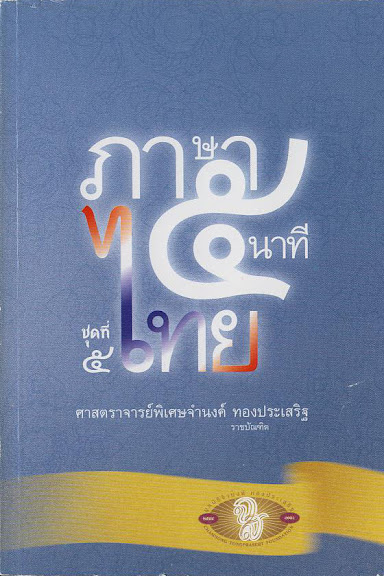
ภาษาไทย ๕ นาที by จำนงค์ ทองประเสริฐ
The title means '5 Minutes of Thai Language'. This series is up to volume 9 now. I own 3 and 5, I believe. They consist of transcripts from Prof. Chamnong's long-running five-minute radio show of the same name. I'm not sure if it's still on the air, but I don't think so.

A fellow of the Royal Institute who has held pretty much every position of leadership in that organization over the years. The good professor is in his seventies, but still active at the Royal Institute, as far as I know. I interviewed him for my senior thesis back in 2005.

About 150 transcripts are freely available on Prof. Chamnong's website (note: that link goes to page 1 of 3, so be sure not to miss the full set of available articles). I believe this represents the full contents of vol. 3, possibly more.

ภาษาไทยวันละึคำ by กาญจนา นาคสกุล
"Thai language, A Word a Day" was a recurring five-minute television spot which ran for several years in the early 90s, I believe. Transcripts from each broadcast year have been published, as you can see from this book cover here. Last year a hardcover compendium called ภาษาไทยวันละคำ ฉบับรวมเล่ม was released, compiling the show's entire run into one big (800+ page), alphabetized volume.

Dr. Karnchana is also a fellow of the Royal Institute. When I interviewed her in 2005, she was one of the two vice-presidents of the Royal Institute. Her term of service in that position may be up by now, but she's still active in the Royal Institute, and was in the news last year for spearheading the พจนานุกรมคำใหม่ 'Dictionary of New Words' project at the Royal Institute.

She also has a semi-regular column called ภาษาไทยวันนี้ 'Thai Language Today' in the weekly magazine สกุลไทย that has run since 2000. You can access the archives on Sakulthai.com, totaling nearly 200 columns.

ภาษาไทยวันนี้ by สมพร จารุนัฏ
Although it shares a name with Dr. Karnchana's column, I don't think there is any relation with this series of books published by the Ministry of Education.

The MOE has a website (unfortunately offline right now) on which you can view and download hundreds of their textbooks in PDF format for free, these books included, among dozens of other Thai-language textbooks ranging from grade 1 through grade 12. This is the first time I've tried to visit the site in a while, so hopefully it's not offline permanently. Excellent little website with more free books than you can shake a stick at.

There are other series and other individual volumes. ภาษาไทยนอกจอ, ภาษาคาใจ (3 volumes), ภาษาไทยไขขาน (half a dozen or more, I think--also by Dr. Chamnong), others. I'm also a fan of the column มองไทยใหม่ 'A New Look at Thai' by นิตยา กาญจนะวรรณ, which runs weekly in มติชนสุดสปัดาห์ (Matichon Weekend). Several compilations of Dr. Nitaya's articles have been published but are now out of print. You used to be able to get all of the back-issues of her column for free on Matichon's website, but now you have to be a paying customer (not to paying customers: read her column).

One of the Royal Institute's present initiatives to "improve" the public's use of the Thai language is a radio show called รู้ รัก ภาษาไทย 'Know and Love the Thai Language'. Transcripts are regularly updated on their website here. You can also check out other compiled articles on language (among other topics) on this page of their site. Many of these were written by Prof. Chamong and Dr. Karnchana, so there may be some overlap with other books. I've never checked. But there are hundreds of articles to peruse.

There's a ton of material out there, and much of it free. If you know of any other resources, online or book, please post a comment or drop me an email (my address is at the bottom of the blog).

Etymologist 15: Ghosts and butterflies

I found another connection that is shared between multiple Southeast Asian languages: use of a word for 'spirit' or 'ghost' in the word for 'butterfly'.

In Thai the word for 'butterfly' is ผีเสื้อ /phǐi sɨ̂a/. The first syllable is the common Thai word for 'ghost'. The second word is the word for 'shirt', but I suspect that may be a coincidence, and the เสื้อ in ผีเสื้อ doesn't actually have to do with shirts. But I don't know for sure one way or the other.

In Mon, the word is /kəlok həlɛ̀a/, where /kəlok/ means 'Spirit, daemon', and /həlɛ̀a/ means 'Indian' (i.e. a native of India), from the Burmese ကုလား  /kəlá/ (comparable in meaning to Thai แขก, although probably cognate with Thai กุลา). [Data from Harry Shorto's 1962 A Dictionary of Modern Spoken Mon.]

In Burmese, the word for 'butterfly' is လိပ်ပြာ /leiʔ pyà/. This is also the word for spirit (corresponding in meaning to Thai วิญญาณ 'spirit', not ผี 'ghost', but the ideas are connected). [Data from SEAlang. You can download Burmese fonts at that link.]

So again we see a case where although the words are completely different, a very similar semantic concept appears in these neighboring cultures. I checked in Khmer and a few other dictionaries, and I didn't notice this in any other Southeast Asian languages.

It's an interesting question to ponder: why the connection between butterflies and supernatural spirits? Any thoughts?

August 1, 2008

Etymologist 14: Mangoes and cashews in Thai and Mon

The last week or so I've been spending a lot of time with Harry Shorto's A Dictionary of Modern Spoken Mon (1962). With its companion volume, A Dictionary of the Mon Inscriptions (1971), it makes for some interesting reading.

Personally, I don't know a lot about Mon, but historically it has had a lot of influence on Thai, which mostly goes unrecognized. The Mon were in Southeast Asia more than two millennia before the arrival of the Tai (ancestors of the Thai, Lao, Shan, etc.) from an area of what is now southern China.

Yesterday I noticed a connection, but of a different kind. It's a semantic similarity between modern spoken Thai and modern spoken Mon.

In Mon, just as in Thai, the word for 'cashew' comes from the word for 'mango'. The Thai word for 'mango' is มะม่วง /mamûaŋ/ (from หมาก /màak/ + ม่วง /mûaŋ/); the Mon word is /krɜk/. Now, obviously there's no common origin between those two words.

The mango/cashew connection presumably derives from their similar shape. The cashew nut is native to Brazil, and was spread throughout the world by the Portuguese, who were among the earliest Europeans in Southeast Asia. The cashew took well to the tropical climes of South and Southeast Asia. Today, Vietnam is the largest producer of cashews in the world, with more than four times the annual output of Brazil; India produces more than double that of Brazil.

(Interesting side note: In areas of Thailand's south, the cashew is called กาหยู /kaayǔu/, which, like English 'cashew', comes from the Portuguese word acajú, and ultimately from the indigenous Tupi word acajuba.)

The standard Thai word for 'cashew' is มะม่วงหิมพานต์ /mamûaŋ hǐmmaphaan/ 'Himmaphan mango'. The Thai word หิมพานต์ /hǐmmaphaan/ is from Himavanta, the name of the forest in Hindu mythology which lies at the base of Mount Meru.

The Mon word for 'cashew' is /krɜk soiŋkhɜ̀/. The phonology obscures it a bit, but the second word is from Sanskrit /siṃhala/ (corresponding to Thai สิงหล /sǐŋhǒn/). It is the Mon word for Ceylon/Sinhala, which was partially ruled by the Portuguese in the 17th Century, before the Dutch moved in, and then the British, before modern independence under the name Sri Lanka.

So for Thais, a cashew is a 'Himavanta mango', while for Mon it's a 'Sinhala mango'. The Mon name presumably comes from the nut's place of origin from the Mon perspective. I'm not sure how the Thai word came to refer to a mythical forest in the Jataka tales. Does anyone else have any insight into that?

Regardless, it's an interesting semantic similarity. I wonder if there was any influence in one direction or the other.

March 12, 2008

Loanwords 4: English loanwords in 1892

There's something irreconcilably nerdy about reading the dictionary. What can I say, I like dictionaries. It's not like I read them cover to cover--I browse. Electronic dictionaries are good for many things, but I love the simple serendipity of flipping through a paper dictionary and finding great new words, or making unexpected discoveries.

I also have a thing for old dictionaries. Take my digital critical edition of the first Thai-English dictionary as proof of that. It's based on a mid-19th Century manuscript of unknown provenance in the British Museum. I gradually typed out the 500-page document over the course of 2006. It was roughly equal parts fascinating and tedious. I got pretty good at reading the chicken-scratch English. The Thai is much more easy to read, ironically, despite a few orthographic quirks of the era.

I typed it up from a digital scan made of a microfilm copy of the manuscript. Since old dictionaries are so hard to find in the flesh--er, paper--a decent scan will do. And thanks to such scans I've been able to examine many early Thai dictionaries. No doubt, without this technology I never would've gotten to read through them closely even if I did find them in some library.

Recently I've been enjoying E. B. Michell's 1892 work A Siamese-English Dictionary, For the use of students in both languages. The book is in the public domain, and downloadable from Google Books within the United States, or viewable on SEAlang.
I don't know much about Michell other than what the title page says: "M.A., Barrister-at-Law, late Legal Adviser to His Siamese Majesty's Government." The Majesty in question here is King Chulalongkorn, or Rama V, who reigned from 1868 to 1910. Google tells me Michell's full name is Edward Blair Michell, and that's the extent of my knowledge of him.

I posted last month about finding 'copy' in this dictionary, spelled กอปี้, whereas today it's usually spelled ก๊อปปี้. As it turns out, there are a number more loanwords that Michell says come from English. And interestingly, all of them are still used:

ไปรเวต = private; I've only seen this used nowadays to refer to casual attire. I first encountered it when my wife and I had pictures taken before our wedding. We had pictures taken in a few different outfits, including ชุดไปรเวต. This usage must be uniquely Thai, because 'private outfit' doesn't sound like anything I'd normally have my picture taken in.

แปลน
= plan; I still hear this used as an alternative to แผน. I don't know the etymology of แผน, but it seems to be preferred as the native (or more native sounding?) alternative to แปลน.

แหม่ม [แหฺม่ม] = Ma'am; this has gone from referring to a woman Westerner to being a very popular girl's nickname.

ออฟฟิศ
= office; it's even still spelled this way, with the final ศ. You can usually spot a loanword as being of 19th Century origin by the presence of these less common letters usually reserved for loans from Pali and Sanskrit. Two other examples are โปลิศ 'police' and อังกฤษ 'English'.

บ๋อย = boy; this specifically refers to a servant boy or a waiter. I still hear this around.

บิล = bill; everybody knows this one, don't they? Pronounced 'bin' in the typical Thai way, and nowadays usually paired with 'check' เช็ค as เช็คบิล used to ask for the check at a restaurant. In this context, 'check' and 'bill' are actually two words for the same thing. I would hypothesize that if 'bill' was already in the language, and so was 'check' in the verb sense 'to check, to examine', then the influence of English 'check please' in the restaurant setting influenced the birth of the quirky Thai-ism 'check bill', which in the Thai context it means to literally check the bill.

แบงก์ = bank, meaning the financial institution; more commonly spelled แบงค์ nowadays.

ปิ่น = pin; used for one's hair. Immortalized in Thai in phrases like ปิ่นเกล้า pin klao, a pin for holding the hair in place when pulled up on the crown like a bun.

ฟุด = foot (the unit of measure); nowadays spelled ฟุต, reflecting the final t of the English spelling.

มรสุม [มอ-ระ-สุม] = monsoon; I don't think this is actually from English as Michell claims. Etymonline traces its route into English as Arabic > Portuguese > Dutch > English:
"trade wind of the Indian Ocean," 1584, from Du. monssoen, from Port. monçao, from Ar. mawsim "appropriate season" (for a voyage, pilgrimage, etc.), from wasama "he marked." When it blows from the southwest (April through October) it brings heavy rain, hence "the rainy season" (1747).
I'd say it's quite plausible that it came into Thai from Arabic, perhaps through Persian (which has many Arabic loans), since Thai has other words of purported Persian origin, like องุ่น 'grape', กุหลาบ 'rose', and กะหล่ำ 'cabbage'. Also notice that 'morasum' is slightly closer to 'mawsim' than to 'moncao' or 'monssoen' (but not conclusively so). If it's a newer loan, it may have come through Portuguese, which gave Thai at least one other early loanword, สบู่ 'soap'.

February 5, 2008

Etymologist 13: Thaksin and Dexter

I found another fun connection today. If you've read my post about the Indic names of the compass directions, you will remember that the four major compass points are บูรพา /burapha/ 'east', ปัจฉิม /patchim/ 'west', อุดร /udɔɔn/ 'north', and ทักษิณ /thaksin/ 'south'. Another meaning for these four words is (in the same order) 'front', 'back', 'left' and 'right'.

The word ทักษิณ comes from the Sanskrit daksinah 'on the right hand, southern, skillful.' What I learned today that I'd never known before was that dexter also means 'on the right hand, skillful' (its etymological opposite is sinister). After the initial spark of intuition, some quick checking shows that these are indeed etymological cousins, both descended from the Proto-Indo-European root *dek-.

Thaksin and Dexter are both used as names in different countries. And some would have you believe that that Thaksin and this Dexter have more in common than just the origin of their names. I smell a conspiracy theory...

January 9, 2008

Old News: 19th Century comedy!

I've found a fun piece from the Bangkok Recorder to share today. I think it was published as filler, because it's a short humorous anecdote that ran on the inside of the back page of the issue, the least important page of a newspaper. Kind of like the forerunner to Reader's Digest using jokes to fill in the space after articles, I guess.

As with the last two installments of Old News, it was first published on November 3, 1865.

A mild warning
ความเตือนอันอ่อน
ครั้งก่อนมีขุนนางผู้ใหญ่, ได้นั่งกินโตะด้วยกันกับคนอื่นมากนั่งแน่นกันนัก. มีคนหนึ่งที่พูดมาก ๆ นั่งใกล้กันกับคนนั้น. คนที่พูดมากนั้น, ครั้นพูดแล้วก็ยกมือไปมาตามคำที่เขาพูดด้วย. ขุนนางนั้นจึ่งบอกกับเขานั้นว่า, มือของท่านเปนเครื่องรำคาญใจข้าพเจ้านัก. คนนั้นจึงตอบว่า, ขอรับกระผมคนแน่นมาก, เกล้าผมไม่รู้ที่จะเอาไว้ที่ไหนได้, ขุนนางนั้นจึ่งตอบว่า, ถ้าอย่างนั้น ก็เอามือยัดไว้ในปากเสียเถิด.
And my translation:
A mild warning
Once an important nobleman was having a meal with many other people, all crammed around the table. One person sitting near him was talking nonstop. When the man was speaking he would wave his arms about along with his words. So the nobleman said to him, "Your hands are an annoyance to me." The man replied, "my lord, the table is so crowded that I don't know where to put them!" The nobleman thus replied, "If that's the case, then stick them in your mouth!"
As far as I know, Dan Beach Bradley wrote (or often translated) the entire contents of the newspaper, which makes me wonder if this joke isn't translated from some Western source. It strikes me as vaguely familiar, but I can't place it. Has anyone heard a story similar to this in English?

Something interesting to notice about the language usage:
The pronoun เกล้าผม. Many Thai higher-register pronouns (those used to show respect to superiors) comes from words that refer to either the head (as in this case) or the feet (as in ใต้เท้า). As I understand it, เกล้าผม makes reference to the topknot that was historically worn at the apex of the head by children (until ceremonially cut). But it's particularly interesting to see it in the same sentence with กระผม. I had previously wondered about the origin of กระผม, and considered the possibility that it is a phonologically reduced form of เกล้าผม. This example shows how both are used as honorific pronouns, and they seem to be interchange, but the fact that they both show up in the same sentence may be evidence against my little theory. RID99 includes an entry for เกล้ากระผม, a hybrid of these two, but we need a lot more textual evidence before we can clearly lay out the order of origin for the different versions. (Incidentally, this connection with the head demonstrates that it's no coincidence that ผม means both "hair" and "I". The meaning "hair" undoubtedly came first, and gave rise to the respectful pronoun.)

January 2, 2008

Etymologist 12: Is it 'too late' to learn the truth about ทุเรศ?

Folk etymologies are an interesting phenomenon. It's a natural human impulse to want to assign meaning and order to the world around us, and this extends to language. Yet language is extremely dynamic, endlessly evolving, constantly changing. We tend to lack the long-term perspective necessary to make sense of it all. And yet we attempt to find reason within our limited frame of knowledge, and manage to come up with explanations. Sometimes good, sometimes bad. Simply put, a folk etymology is a false conception of the origin of a word or phrase.

There's always some logic behind a folk etymology, though. It has to be plausible. For example, if I claimed that the expression 'groovy' was invented by Lord Zorgath, emperor of the planet Yaxelblurg, because he had an obsession with vinyl records and considered their grooved surface the pinnacle of aesthetic advancement, you'd likely have the nice young men in their clean white coats come to take me away. But if I told you that the money given to someone as a gratuity for some service is called a 'tip' because it comes from the phrase 'to insure promptness,' well, you just might believe me (but don't--it's another folk etymology).

In English, competing folk etymologies abound. The globally ubiquitous expression 'OK' is perhaps foremost in sheer number of dubious claims of origin, but expressions like "mind your Ps and Qs", and the curse words that begin with f and sh respectively have plenty of colorful stories purporting to capture their true origins, too.

Muc
h of the time, the true etymology of a word is just plain boring by comparison. And as it happens, most folks don't know the details of sound changes and semantic shifts and derivations and inflections that drive language change. So folk etymologies are born. Someone wonders about the origin of this word or that phrase, and comes up with what seems like a logical story. And even in the face of linguistic evidence, people may still want to believe the more interesting version. So folk etymologies persist.

It's no surprise, then, that Thai has folk etymologies, just like English. One I've heard is for the word ทุเรศ. A quick check in RID99 returns this definition:
ทุเรศ (ปาก) คําพูดแสดงความรู้สึกเมื่อประสบสิ่งที่ขัดหูขัดตาหรือเป็นที่น่าสมเพชเป็นต้น.

/thureet/ colloq. An expression to show the feeling of when one experiences something displeasing, or deplorable, etc.
The claim of the folk etymology is that this expression comes from the English phrase 'too late'. Now, I understand that 'too late' is used by some Thais as a way of disguising the word ทุเรศ, just like some write 'กวน teen' in place of กวนตีน. It gives it a lighthearted or humorous angle, and can help take the edge off of the word's potential impoliteness. So it's possible that some (or many) folks are only using it to be ironic or funny. Nevertheless, some attempt to claim 'too late' as the legitimate origin of the Thai word.

The claim is that Englishmen came to Siam and set up businesses which employed native Thais. These Thais were not used to the strict timekeeping of the Westerners, and so when they failed to show up to work on time they were told they were "too late" by their English-speaking bosses. The Thais heard "too late" as ทุเรศ, which came to be a term indicating disagreeable or unacceptable behavior, etc.

Nitaya Kanchanawan does a good (and very polite) job of eviscerating this theory, which she heard on TV, in her column มองไทยใหม่ in Matichon Weekly (มติชนสุดสัปดาห์, April 28, 2006, p. 76). You can read my translation of that column here, including the original Thai.

Let's take a closer look at how this folk etymology should have been debunked, and definitely should not have made it onto the Thai airwaves, especially as part of a show about preserving Thai culture, as Dr. Nitaya states in her column.

The first evidence is from the spelling. ทุเรศ looks very much like a Thai spelling of an Indic word. It's true that it does not look much like a native Thai word, but it certainly does not look like an English word. The ร does not match the l in English 'late', and the final consonant ศ is usually a sure sign of an Indic loan.

Anyone who has experience with Thai poetry and classical literature (and all Thais do during their years of compulsory education), the ending เอศ should be familiar. It is one of the optional endings which can be compounded with a root to create a poetic version of a word, maintaining the original meaning. This would be done either for rhythm or rhyme's sake. This sort of compounding for the sake of rhyme is referred to as เข้าลิลิต, and in the case of the suffix เอศ, it's called เติม ศ. เข้าลิลิต.

I've translated a passage explaining this poetic device from this site:
เติม ศ. เข้าลิลิต refers to appending the -อีศ (SKT īśa) to the end of a word without changing the meaning, for the benefit of composition, e.g. to increase the number of syllables, or to give a word a low tone (in fact, it usually results in a falling tone, but since it is a dead syllable, it can be used in place of a low tone), or to make a heavy syllable [i.e. a syllable with a long vowel or final consonant], as needed.
The Sanskrit īśa becomes Thai เอศ, for example, Sanskrit kamala- īśa becomes Thai /ka-ma-lê:t/ (กมล + เอศ = กมเลศ).

This is a clear model for ทุเรศ to follow, which we would expect to be made up of ทุร- and เอศ. And what do you know! RID99 quickly gives up the likely culprit:
ทุร- [ทุระ-] ว. คําประกอบหน้าคําศัพท์ หมายความว่า ชั่ว, ยาก, ลําบาก, น้อย, ไม่มี, เช่น ทุรค ว่า ที่ไปถึงยาก, ทางลําบาก. (ส.).

/thura-/ adj. A prefix meaning evil, hard, difficult, few, none, e.g. ทุรค 'a place difficult to reach, a difficult path' (Skt.).
This fits the meaning of modern ทุเรศ quite well. It's seen in compounds like ทุรกันดาร (as in ถิ่นทุรกันดาร 'wasteland'), and is the etymological sibling of the prefix ทร- (as in ทรราช 'tyrant', ทรยศ 'betray', ทรมาน 'torture'). The semantic connection with the modern colloquial usage of ทุเรศ is clear enough.

The second line of evidence is text citations. RID99 falls short on this particular entry, even failing to note the word's Indic origin. Fortunately, Matichon Dictionary comes to the rescue:

ทุเรศ ว. ยาก, ลำบาก, เช่น เราแจ้งทางทุเรศเขตอรัญ สัตตภัณฑ์คั่นสมุทรใสสี (กากี). ก. หลีกลี้ไปไกล, ไปห่างไกล, เช่น หมู่สุบรรณพันโกฏิในสิมพลี ทฤษฎีแล้วทุเรศจากสถาน (สมบัติอมรินทร์). (ปาก) ว. อุจาด; คำพูดแสดงความรู้สึกว่าสิ่งนั้นๆ บุคคลนั้นๆ หรือการกระทำนั้นๆ เป็นที่น่าสมเพชหรือขัดหูขัดตา.

/thureet/ adj. Difficult, troublesome, e.g. เราแจ้งทางทุเรศเขตอรัญ สัตตภัณฑ์คั่นสมุทรใสสี (กากี). v. flee far away, go far away, e.g. หมู่สุบรรณพันโกฏิในสิมพลี ทฤษฎีแล้วทุเรศจากสถาน (สมบัติอมรินทร์). (colloq.) adj. disgusting; an expression to show the feeling that a thing or person or action is deplorable or displeasing.
Matichon includes two citations, both dating from the reign of Rama I (1782-1809). The nails are starting to go into the coffin of this folk etymology. From these citations alone it becomes utterly unlikely that a well-formed Thai poeticism would have anything to do with English, but indulge me in eliminating any possibility.

The earliest contact of British traders with Siam that I can find record of is a meeting of Captain William Keeling of the East India Company with an ambassador of Siam at the Javanese city of Bantam in 1608*. This doesn't yet approach setting up businesses and hiring Thai employees on Siamese soil, but we can confidently say that there was no possibility of such a situation taking place with English speakers prior to 1608. A citation of ทุเรศ prior to 1608 should close the case on the origin of this phrase. And Dr. Nitaya is the one who provides it, from the same article linked above:
If we go back to the time of King Trailokanat of Ayutthaya, we find that he ordered a meeting of royal scholars to compose the Mahajati, in the year 1482.

In the Matsi Sermon, when Princess Matsi reproaches Prince Wetsandon for giving their two children to Chuchok, the passage reads:
"Princess Matsi responded, when the Prince had given her two true friends as alms, 'Why do you torture me? For what purpose do I suffer to go about in search of them throughout the night?"
This passage shows that /thureet/ has been used since the Ayutthaya period, and also probably before the establishment of farang businesses.
[Original Thai is here. I'm not extremely confident about my translation of the passage. Corrections welcome.]
In fact, 1482 predates the earliest known contact with any Western nation, the first being Portugal in 1511. The 'too late' folk etymology makes for a good story, but it turns out that's all it is.


*Anderson, John. 1890. English Intercourse with Siam in the Seventeenth Century, p.46. [Downloadable via Google Books within the United States, as far as I know. I have the PDF saved offline.]

October 28, 2007

Etymologist 11: ปฏิ- words and language modernization

Thai, like many languages, has been undergoing a conscientious process of modernization for several decades. This means there are people who intentionally coin new Thai words to correspond to words in English or other languages. The work is never really through, however, as new words are always coming up that need Thai equivalents. One option is to simply borrow the foreign word directly (such words are known as ทับศัพท์), but some view this as a corruption of the language. In Thailand, the many committees of the Royal Institute do most of this work. They give us words like โลกาภิวัตน์ for 'globalization', and คณิตกรณ์ for 'computer'. Sometimes they catch on (as with วัฒนธรรม 'culture' or นโยบาย 'policy'). Other times they fail miserably (คณิตกรณ์ 'computer' is a great example of failure--คอมพิวเตอร์, and its abbreviation คอม, are ubiquitous).

One possible strategy for simplifying this never-ending process is to create a set of tools in Thai to correspond to English. That is, to systematically use one Thai morpheme* to correspond to a given English morpheme. This sounds great in theory, but it's difficult in practice, because any given morpheme can have any number of meanings. Thus, this has only been done haphazardly in Thai.

Consider the example of ปฏิ-. It's a prefix borrowed from Indic, meaning (according to RID99) ตอบ, ทวน, กลับ. I
n several coinages, ปฏิ- corresponds to the prefix re- in English:

ปฏิรูป = reform
ปฏิวัติ = revolt
ปฏิกิริยา = reaction
ปฏิกรณ์ = reactor (e.g. nuclear)

These are calques (a.k.a. "loan translations") from English:
ปฏิ + รูป = re + form
ปฏิ + วัติ = re + volt (meaning 'turn back', related to revolve)
ปฏิ + กิริยา = re + action
ปฏิ + กรณ์ = re + actor/agent

Here are a few less common ones, which are looser calques:
ปฏิกรรมสงคราม = reparations
ปฏิสังขรณ์ = restore/renovate (a building)

There's also the common word ปฏิเสธ "reject", but it isn't a recent coinage, rather an existing word expanded to include the meaning "reject". It's a long-standing term for the "negative" mood in grammar (i.e. the opposite of "affirmative").

Beyond that, there are a number of relatively common Thai words with this prefix that don't correspond to re- words in English:

ปฏิทิน = calendar
ปฏิบัติ = to carry out, to put into practice
ปฏิญาณ = to vow, swear an oath

Given the success of neologisms like ปฏิรูป and ปฏิวัติ, you'd think it would be easy to expand ปฏิ for other re- words like recycle, renew, etc. The problem you run into is that re- has a related meaning which doesn't quite match ปฏิ-: "again". In fact, this is probably the primary meaning of re- in most English words its found in. So while ปฏิ- fits some words, it doesn't quite fit others.

But what can you expect? Systematically capturing the nuances of one language in another would require a pretty massive restructuring, for two languages as different as English and Thai. And for a language like Thai, language modernization has always been a tightrope walk across the fine line between keeping up with the pace of the world and sacrificing what Thais view as
the most significant aspect of their society and culture: their language.


*
A morpheme is the smallest meaningful language unit. For example, the word bicycles has three morphemes: bi-, cycle, and -s. This tells you it's a plurality of two-wheeled things.

September 21, 2007

Etymologist 10: Mantra

After going on about mantras in my last post, I realized that the word mantra is a good candidate for the next installment of Etymologist. Heading over to etymonline, we see:
1808, "that part of the Vedas which contains hymns," from Skt. mantra-s "sacred message or text, charm, spell, counsel," lit. "instrument of thought," related to manyate "thinks." Sense of "special word used for meditation" is first recorded in Eng. 1956.
This corresponds to Thai มนต์ or มนตร์ (the former is from Pali and the latter from Sanskrit; มนต์ is the more common spelling overall, though in some compound expressions one or the other is conventionalized). RID99 tells us:
มนต์, มนตร์ น. คําศักดิ์สิทธิ์, คําสําหรับสวดเพื่อเป็นสิริมงคล เช่น สวดมนต์, คำเสกเป่าที่ถือว่าศักดิ์สิทธิ์ เช่น ร่ายมนตร์ เวทมนตร์. (ป. มนฺต; ส. มนฺตฺร).

"n. sacred words, words to pray for good fortune, ex. suatmon; incantation that is held as sacred, ex. raaymon, weetmon. (P. manฺta; S. manฺtฺra)" [My translation]
This is a straightforward correspondence, although English obviously borrowed the word from Sanskrit, while Thai has both Pali and Sanskrit forms. สวดมนต์ is a common term meaning to pray, in the sense "to recite a Pali prayer." We might translate น้ำมนต์ as "holy water", meaning water that a Buddhist priest has prayed over
(I'm not sure what term the Catholic church in Thailand actually uses--anyone?).

September 12, 2007

Etymologist 9: Can't hold a candle to the moon

I found a really cool link while researching the sandalwood/ไม้จันทน์ connection.

First, I didn't know until just now that the Thai words จันทน์ "sandalwood" and จันทร์ "moon" were related. It turns out that both words (borrowed from Sanskrit) are from the PIE base *kand- meaning "to glow, to shine." The literal meaning of จันทน์ would be "(wood for) burning incense," referring to the common use of that variety of wood. จัทนร์ would mean "shining; glowing." It has come to mean "moon" because the moon shines.

Our modern word candle comes from the Old English candel, from Latin candela "a light, torch" in turn from candere "to shine." Which is cognate with Sanskrit candra-, and therefore related to Thai จันทร์. (Also from the same Latin root are our English words candor, candid, incandescent, and incendiary, among others.)

Etymologist 8: Sandalwood and ไม้จันทน์

Continuing in the vein of recent posts, on etymological links between English and Thai (through Sanskrit), today let's look at sandalwood.

First off, the name apparently has nothing to do with the footwear. The name sandal meaning open-toed shoe comes from Old French, which in turn is from the Latin, which comes from the Greek, and ultimately is probably a Persian word, says the Online Etymological Dictionary*.

The sandal in sandalwood comes into English via a similar path. It would have been a homophone with the footwear in Old French, but from different Latin and Greek roots. It came into Greek from either Persian or Turkish, but ultimately comes from the Sanskrit candana-m. Sandalwood in Thai is called ไม้จันทน์, which transcribed in the Mary Haas method (minus ไม้) is canthana. (Note that this is not the same spelling as จันทร์ "moon"--though I'll get into how these two words are related in a future post).

So that's the story of the connection between sandal(wood) and (ไม้)จันทน์.

*
I just noticed that this, the formal name for the English etymology resource found at etymonline.com, ironically has the initials OED--ironic because it's the poor man's Oxford English Dictionary. It's no substitute, but OED.com charges a hefty sum to subscribe.

September 11, 2007

Etymologist 7: Emerald/มรกต

Today I have another interesting connection between Thai and English to share. The Thai word for emerald, มรกต, is actually cognate with its English equivalent. First let's check out the RID99 definition of มรกต:
มรกต [มอระกด] น. ชื่อรัตนะอย่างหนึ่งในจำพวกนพรัตน์ มีสีเขียว.
"The name of a type of precious stone, one of the nine gems, green in color." (my translation)
Etymonline.com has this to say about the origin of emerald:
c.1300, from O.Fr. emeraude, from M.L. esmaraldus, from L. smaragdus, from Gk. smaragdos "green gem," from Sem. baraq "shine"... Skt. maragdam "emerald" is from the same source...
To sum up, we have English emerald coming from Greek smaragdos, related to the Sanskrit root maragdam. The Sanskrit has another form (or perhaps another transliteration, I'm not sure)--marakatam. The etymologies given in RID are woefully incomplete, so it's not surprising they don't acknowledge the Indic source of the word, but it's a pretty obvious connection between marakatam and มรกต. And thus between มรกต and emerald.

Etymologist 6: Bandana

I hear you asking, why is he writing a post on the origin of bandana on a blog about Thai? Well, I was recently enjoying a read through the Wikipedia page on Sanskrit loanwords in English, and found some interesting connections between English and Thai.

For those who weren't aware, Sanskrit and English are linguistic cousins. Very distant cousins, though, as part of the rather huge Indo-European language family (this means they descended from a common language--what we call "Proto-Indo-European" or PIE). And while Thai isn't part of the same family, it has an immense number of Indic (mostly Sanskrit and Pali) loanwords. Which makes for some interesting connection between English and Thai.

Which brings me to bandana. According to etymonline.com, bandana is attested in English from 1752, coming from Hindi bandhnu, a method of dyeing, from the Sanskrit badhnati "binds". The method was so-called because the cloth was tie-dyed. Go ahead, enjoy the flashback to the early 90s. Turns out the Indians were doing it three centuries earlier.

The word bandana is from the same PIE root as band in the sense "something that binds".

This is where the connection to Thai comes in. There are two cognates in Thai: พันธ- [พัน or พัน-ทะ]
, and พันธน- [พัน-ทะ-นะ]. Both are from the same Indic root. I'm not sure about the difference in the original language, but in Thai the former is usually a verb, meaning "tie, bind" (although it can be used as a noun to mean "obligation") and the latter is usually a nominalized form, "tying, binding; tying implement, binding implement". But really, they're basically the same word.

Looking into this causes me to wonder about the very similar word พัน. It's defined in RID99 as "to wrap around with a rope or something similar" (that's my quick, lazy translation). That sure sounds like to tie or bind, if you ask me. I looked it up in the Proto-Tai'o'Matic, which handily shows us what various scholars have written about the origins of native Thai words (as opposed to loanwords). Only one of the works, Jonsson91, claims a native origin for พัน:

Jonsson: [ *b- (A4) B16-31 ] PSW: *ban "to encircle"

I'd hardly call that conclusive, but I don't have any hard evidence to show that พัน comes from พันธ, so for now we'll put it in the "interesting correspondence that requires further investigation" category. It's the best I can do for now.

August 1, 2007

Etymologist 5: โลกาภิวัตน์

Globalization refers to the modern trend toward increased interdependency, connectivity and integration across the world, be it economic, political, or cultural. The world is becoming smaller, in other words, with our increased ability to communicate, travel, and otherwise interact with the rest of the globe.

The term for this in Thai, as coined by the Royal Institute, is โลกาภิวัตน์ (which has replaced an earlier term, โลกานุวัตร).

This word is an example สนธิ in Thai. สนธิ, (aka sandhi*), is a blanket term referring to various phonological processes that can occur when you combine two words into a compound. There are various types of sandhi: tone sandhi, vowel sandhi, In the case of โลกาภิวัตน์, we see vowel sandhi, where the vowel changes when you combine the two roots.

The component parts here are โลก and อภิวัตน์. So why the long vowel in โลกา?

Thai words from Indic origins have a standalone form and a "combining form." This usually consists of an extra vowel at the end, that is hidden or suppressed in its standalone form (or when it's at the end of a compound). Sometimes it's written but not pronounced, as in ประวัติ, whose combining form is (usually) pronounced [ประ-วัด-ติ].

There are actually two types of compounding that Thai borrows from Indic languages (i.e. Pali and Sanskrit). Besides สนธิ, there is also สมาส [สะ-หมาด]. The difference is that in สมาส, the existing vowels of the component words don't change. (But we do get additional syllables from the combining form).

For โลก, the combining form is [โลก-กะ]. The word โลกทัศน์ "worldview"
is an example of สมาส. โลก+ทัศน์ = [โลก-กะ-ทัด]. Because it is a สมาส compound, โลก takes its combining form.

Back to โลกาภิวัตน์. With สนธิ, you start with the combining forms of the component parts. Vowel sandhi in Thai has certain rules for what happens to two given vowels when you combine them. When you combine the two short อะ vowels (the อะ vowel at the end of โลก in its combining form, and the short vowel อะ at the beginning of อภิวัตน์) it becomes the long vowel อา. โลกกะ+อภิวัตน์ = โลกาภิวัตน์. This process also breaks โลก into two syllables, and อา because the vowel of the second syllable: โลกา. This, in turn, affects the tone. Notice that in โลกาภิวัตน์, โล-กา is two syllables, both mid tone.

To break it down further, อภิวัตน์ is a compound of อภิ (meaning ยิ่ง or วิเศษ) and วัตน์ (meaning ความเป็นไป or ความเป็นอยู่). The combined meaning is การเข้าถึง, การแผ่ถึง, or การเอาชนะ. But in the case of อภิวัตน์ there is no sandhi going on, because spelling/pronunciation change is needed. The compound อภิวัตน์ itself is formed by สมาส.

So the literal meaning of the entire word is "conquering the world" or "spreading throughout the world."

Other examples of สนธิ:
  • เดชานุภาพ (great power/might) is from เดช (power) + อานุภาพ (power, greatness)
  • ราชูปถัมภ์ (royal patronage) is from ราช (king) + อุปถัมภ์ (patronage, support)
  • พจนานุกรม (dictionary) is from พจน์ (word) + อนุกรม (order, or sequence)
  • มกรคม (January) is from มกร (dragon) + อาคม (arrival)
  • ธันวาคม (December) is from ธนู (bow) + อาคม (arrival)
Other examples of สมาส:
  • พุทธศาสนา [พุด-ทะ-สาด-สะ-หนา] (Buddhism) = พุทธ [พุด] (Buddha) + ศาสนา (religion). Cf. the non-compound form ศาสนาพุทธ [สาด-สะ-หนา-พุด]
  • เศรษฐกิจ [เสด-ถะ-กิด] (economy) = เศรษฐ [เสด] (literally excellent or best, in this sense, money) + กิจ (work, business).
With a bit of practice, it gets easier to unravel long words into more easily digestible parts.

[Sources: RID99,
จดหมายข่าวราชบัณฑิตยสถาน ปีที่ ๔ ฉบับที่ ๔๑, ตุลาคม ๒๕๓๗.
----------------
* It comes from Sanskrit, meaning "put together" or "combine." This root is also seen in the Thai word ปฏิสนธิ, meaning conceive (a child). ปฏิ+สนธิ = the result of combination, hence conceive.

July 20, 2007

Etymologist 4: แม่มด

[Note: If you don't see the Khmer, you can get a free Khmer Unicode font here.]

The word มด in Thai, so far as most people know (including Thais), refers to the little insect with a sweet tooth that always ruins picnics. Or, to put it a bit more scientifically, insects of the family Formicidae. Ants!

And yet, there's this word มด that we find most commonly in the words แม่มด and พ่อมด, or "witch" and "wizard." They appear to literally mean "mother ant" and "father ant," but intuition leads us to reject this as a viable interpretation.

Aj. Chamnong Thongprasert (จำนงค์ ทองประเสริฐ), in an installment of his newspaper column ภาษาไทยไขขาน (Thai Unlocked) from the mid-80s (available on the Royal Institute website), discusses one possible origin.

The late Banchob Bandhumedha (บรรจบ พันธุเมธา) told him that Khmer has the word
មត់ /mʊət/ (which would be transcribed in Thai as มต). Here's where I think things get a bit fishy. It's unclear from the article whether Dr. Banchob suggests the rest of the interpretation, or whether Aj. Chamnong extrapolates it himself, but I think it's the latter. The article suggests that Khmer មត់ (and by extension Thai มด) come from Pali มต, meaning "dead," more commonly see in Thai as มตะ. This makes sense, Aj. Chamnong goes on, because witches and wizards are sometimes also called หมอผี in Thai, and a ผี is a dead person (or a ghost).

One of my problems with Aj. Chamnong's theory is that he's making a leap between แม่มด and หมอผี on semantic grounds, instead of etymological grounds. We can translate หมอผี as "witch doctor," meaning a person who heals diseases by manipulating spirits. Nowadays, with the advent of modern medicine, it's often used to mean an exorcist, someone who casts out spirits, the logic being that in both cases the person has the power to control the spirits inhabiting a human. But if แม่มด means แม่มตะ, then the grammar seems off. In แม่+X constructions, X is usually a verb indicating what the female person does (e.g. แม่ค้า, a woman who sells, hence a female shopkeeper) or a noun indicating the person's domain (e.g. แม่บ้าน or แม่ครัว). มตะ just means dead, or to die, so in this case it means what, a female dead person? I'm not buying it.

So for me, Aj. Chamnong's explanation doesn't satisfactorily explain why the phrase is แม่มด and not something more like, say, หมอมด. I did some more looking around. It turns out that Khmer also has the phrase មេមត
/mee mʊət/, which corresponds exactly to แม่มด, which he doesn't mention (or doesn't know). Looking on SEAlang's Khmer dictionary, it gives this definition of មត់ /mʊət/:
"to act in concert, to have a secret understanding; to inform in advance."

This would seem to discredit the theory of มด being related to Pali, because this word is apparently unrelated to death and dying.

SEAlang's definition for
មេមត់ /mee mʊət/:
"medium, one who can contact the spirit world; witch"

Now, I have to make the disclaimer that I don't know Khmer, but this would appear to be a good source for the Thai phrase. It would mean someone with secret understanding, who knows things ahead of time, i.e. can commune with spirits. Note that medium is a different thing than a หมอผี, too, who heals by controlling the spirits.

I think the case is good that มด comes from Khmer, because it is rarely seen outside the fixed phrases แม่มด and พ่อมด. One exception is มดหมอ, an elaborate version of หมอ. But มดหมอ doesn't mean witch doctor, it just means doctor. As is common with such elaborate nouns, we see มด and หมอ used as an "elaborate pair" in phrases like หามดหาหมอ "see the doctor," which is just an elaborate version of หาหมอ. But outside of this association with witches and doctors, มด is meaningless in Thai, but not so for Khmer. Loanwords tend to have narrower meanings than their source language, which appears to be the case here. There are several other phrases in the SEAlang Khmer dictionary with
មត់.

But whether it is a native Khmer word or not, someone else with more knowledge on that subject will have to help me out on. Given Aj. Chamnong's explanation, though, I find the connection to Pali misguided. I welcome further evidence or discussion.

June 24, 2007

Etymologist 3: มุขตลก vs. มุกตลก

There has been a spelling debate going on in Thai for some 4 years now. It's over the proper spelling of the word pronounced [มุก-ตะ-หลก]. See how I avoided using either of the spellings there? That's right, I went phonetic. Fancy. The two spellings in question are มุขตลก and มุกตลก. If you're not familiar, it's a noun phrase meaning a joke or gag. Something, usually spoken, intended to make folks laugh.

First, let's make it clear that prior to 2003, มุขตลก seems to have been the largely unchallenged popular spelling. It appears that the cause of all the subsequent fuss is Thailand's
Royal Institute. The word first appears in the Royal Institute Dictionary in the 1999 edition, published in 2003*. It gives the spelling is given as มุำกตลก. And if it were any other dictionary, the debate may never have taken place. But as the government's official dictionary of Thai, there was a clash between the commonly accepted spelling and the etymologically correct spelling selected by the Institutes committee of experts.

Part of the reason this has taken so long to resolve is due to the methodology of the Royal Institute in compiling its dictionary. They work on each new revision of the dictionary at a snail's pace. Actually, probably slower. For more than 70 years now, the Royal Institute has been using the committee method, where a group of 10-20 experts with busy lives and other jobs and commitments get together a few hours a week to crank through a few words. They've published editions of the RID in 1950, 1982, and 2003.**

The meeting during which the RID dictionary committee decided มุกตลก should be spelled with the letter ก. ไก่ instead of ข. ไข่ happened in 1985. Math time: 2003 - 1985 = 18. It was published 18 years later, and the committee had changed significantly in that time, so that basically all of the people who were on the committee at that point were no longer on it by the time it was ready for publication.

So let's talk etymology. The case for
มุขตลก with ข. ไข่ is that มุข in this case means หน้า (face), which traces back to Sanskrit mukha meaning the face, mouth, or front. And so the story goes, that in former times, a comedian could make many humorous faces, and so "(funny) face" came to mean "gag/joke."

While a convenient explanation, this smacks of folk etymology to me. I have yet to see any evidence that it developed from this meaning. In the earliest clear uses of มุก/มุข, it's already being used in the sense of a joke or gag. These occurrences date back around 100 years. The textual evidence shows both spellings--มุข and มุก, but this isn't surprising because it appears to have been a colloquial term and shows up in written form only in plays. The compound word มุกตลก/มุขตลก doesn't appear until more recently, and between the time that this compound became common and RID 1999 was published, มุขตลก became the commonly accepted form. So, in fact, the confusion over มุข or มุก predates the compound.


The Royal Institute gives another etymology. They maintain that it has nothing to do with mouths or faces, and that it's a native Thai word--which means the ข in final position isn't etymologically correct, since that would indicate Indic origin. Their claim is that it comes from โม้กิ๊ก, โม้ meaning to fib or (this is still a common word), and กิ๊ก being onomatopoeic for the sound of laughter***. So this would have been a verb meaning to fib or play a trick on for the purpose of comedy. The RID etymology theory goes that as a colloquialism, it was not frequently written down and
went through a rapid sound change to become มุกกิ๊ก, which was shortened to มุก, and switched parts of speech to be used as a noun.

A lot of people still consider RID in error, and many probably don't know but just follow the majority, but there are also plenty of folks willing to follow RID. Googling the phrase เล่นมุก returns 22,000 hits, and เล่นมุข returns 60,000. So both appear to be alive and healthy.

The Matichon dictionary parts ways with RID on this one, giving only the spelling มุขตลก--probably because of common usage, since they claim to be a descriptive dictionary.

So this leads us to ask: does it matter if the spelling is etymologically accurate? It's possible the RID will include มุขตลก in its next edition, since they're not entirely immune to public opinion. Sometimes popularity wins out over etymology. (For example, the word อัตโนมัติ "automatic" etymologically should be อัตโนวัติ, to have the correct meaning from its Indic roots, but its English counterpart is phonologically similar enough that the public got used to the ม version, which is now accepted as correct everywhere.)


Personally, I think the RID origin account is more reliable, since there is textual evidence to show the development from โม้กิ๊ก to มุก, and since they are used in the same meaning. But on this matter, I'm sort of ambivalent about what I'll actually use myself. As it happens, I'm not writing a dissertation on joke theory or anything like that, so I can describe both sides of the argument, then sit back and let them duke it out on their own.

It's all just a joke to many folks, anyway.

* It is called RID 1999 to associate it with an auspicious year--the king celebrated his six-cycle, or 72nd, birthday that year. The previous edition is RID 1982, the 200th anniversary of Bangkok's traditional founding date.
** Now, I know it took more than half a century to complete the Oxford English Dictionary, but that was worked on by thousands of volunteers, a significant dedicated staff, and was actually a respectable piece of lexicography. For the number of years between volumes, the book is basically inexcusable. It is good in some aspects, better than almost everything else available (although it could learn a few things from Matichon), and certainly better than nothing, but it is to dictionaries what the FBI's insanely expensive computer system is to computer systems. Very poor cost-benefit ratio.
***
This is my own analysis of โม้กิ๊ก, so if I'm wrong, please correct me. There are a number of ways to convey the sound of laughter, but using ก as both initial and coda is common. หัวเราะกิ๊ก gets 524 Google hits, หัวเราะกั๊ก gets 35, and หัวเราะก๊าก gets more than 14,000. I can't chop of the หัวเราะ, unfortunately, because independently they have many possible meanings which would render a Google search meaningless.

June 21, 2007

Loanwords 1: English

Anyone who has spent time in Thailand knows that Thai, like many other languages, has a generous helping of English words mixed into the vernacular. Now, English also figures significantly into the technical and academic vocabulary of Thai, where frequently a nativized* version of an English term catches on more than (or in the absence of) a native equivalent. Everything from internet to ultrasound.

Like many other nations (notably France), Thailand has a governmental body charged with regulating the standard language. Thailand's is the Royal Institute (which was modeled after its French counterpart). One of their jobs is to come up with Thai equivalents for English jargon. Yet even this prescribed vocabulary is subject to the court of public approval.

But loanwords are wont to take on a life of their own. Once ensconced, they are subject to change, shortening, compounding--the whole gamut--just like any other word in the language.

Here are some English loanwoards in Thai that I find interesting. (When the pronunciation is not transparent from the spelling, I've given a phonetic rendering in square brackets):

  • เก็ท [เก๊ด] = to get, to understand, to comprehend. As commonly happens, the borrowing language has taken just one meaning of a highly polysemous word and adopted it. So the phrase ไม่เก็ท corresponds to the English, "(I) don't get (it)."
  • เวอร์ [เว่อ] = to be over the top, extreme, pushing the boundaries of believability or propriety. Shortened from โอเวอร์ "over," this word comes from "over the top." For example: เขาชอบเล่าเรื่องเวอร์มาก ฟังแล้วไม่น่าจะจริง "He always tells over-the-top stories. They probably aren't true."
  • โอ = (1) overtime work; (2) okay, acceptable. Sense (1) is from โอที "OT" (which is also used). I've most often heard it as part of the phrase ทำโอ, but not exclusively. Sense (2) comes from "okay," but this snippet specifically means "acceptable, tolerable, not terrible." As in, สอบเป็นไงบ้าง "How did the exam go?" ก็โอ "It went okay."
Now, I could list English loanwords all day--but are there any that you find interesting, or wonder how they've come to mean what they do in Thai? I'll come back to loanwords periodically, and I appreciate any suggestions or questions.

* In linguistics, nativization means the phonological process of adapting a foreign word to the native language's sound system. In English, for example, the nativized pronunciation of the French word croissant is crew-saunt (although there are those who persist with a pseudo-authentic pronunciation); or, take foyer, which has (at least) three competing pronunciations: foy-er, foy-ay, and fwa-yay. The first is firmly nativized (or Anglicized--the specific term for nativization into English); the second has a more foreign "flavor," but is still nativized, because of the first syllable pronunciation, and the fact that the stress is often put on the first syllable (FOY-ay), though I've also heard it pronounced foy-AY; the third is the closest to the original--it definitely sounds foreign (and might come off sounding pretentious to many native listeners).

June 11, 2007

Etymologist 2: คำกร่อน (ต่อ)

When I wrote the previous installment of Etymologist, I didn't look too hard for the first batch of คำกร่อน. In the last several days since I started looking, though, they've been jumping out at me. Coupled with some Googling, I have quite a few new words to share.

There are several unstressed, prefixed words that seem to be commonly reduced:

ตัว > ตะ

ตัวขาบ > ตะขาบ = centipede
ตัวเข้ > ตะเข้ = crocodile (จระเข้ is the formal term--I'm still not sure where จร- [จอ-ระ] comes from; the musical instrument จะเข้ is so called, I think, because it looks like a crocodile's back--this would appear to be a reduced form of จระเข้; and there's also ไอ้เข้, which I think is used more upcountry)
ตัวเข็บ > ตะเข็บ = a kind of small reptile (also called จะเข็บ, interestingly)

ต้น > ตะ
ต้นไคร้ > ตะไคร้ = lemon grass
ต้นเคียน > ตะเคียน = a tree in the dipterocarpaceae family
ต้นคร้อ > ตะคร้อ = soapberry, in the sapindaceae family; fruit traditionally used to make soap

ตา > ตะ
ตาวัน > ตะวัน = sun
ตาปู > ตะปู = nail

สาย > สะ
สายดือ > สะดือ = navel
สายเอว > สะเอว = waist (เอว alone is still common usage, of course)

อัน > อะ
อันไร > อะไร = what
อันหนึ่ง > อนึ่ง [อะ-หนึ่ง] = furthermore, for another thing

ฉัน > ฉะ
ฉันนั้น > ฉะนั้น = therefore, like that
ฉันนี้ > ฉะนี้ = like this, such as this
ฉันไหน > ไฉน [ฉะำ-ไหน] = how, why, for what reason

(We also already saw หมาก > มะ last time.)

Another source of คำกร่อน is reduplicated words (คำซ้ำ):
ริกริก > ระริก
ยิ้มยิ้ม > ยะยิ้ม
ฉับฉับ > ฉะฉับ
ฉาดฉาด > ฉะฉาด
ครืนครืน > คะครืน

Other คำกร่อน of interest:
พยาน ("witness") comes from ผู้ญาณ, meaning a person with knowledge.
จะ, the future tense/irrealis marker, is from จัก, which is still common in poetic usage.

I'm not quite done with คำกร่อน. In the next installment of Etymologist, I'll explore some pronouns and sentence particles of similar "eroded" origin.

June 2, 2007

Etymologist 1: คำกร่อน

In a new (and hopefully regular) feature, I'll examine the origins behind Thai words and phrases. I've decided to call it Etymologist.

For this first outing, let's talk about what are called คำกร่อน, literally "eroded words." That is, words in which certain syllables are shortened or lost over the course of time.

There are a number of terms in linguistics to describe different types of "sound loss":
  • elision (or aphaeresis), which means the loss of unstressed sounds
  • syncope, the loss of final sounds
  • apocope, the loss of medial sounds (sounds between other sounds)
The one Thai term covers all of these different terms. Sometimes these คำกร่้อน in Thai are still of obvious origin, such as the typical shortening of มหาวิทยาลัย (university) to มหา-ลัย. The motivation behind this sort of shortening is clear: economy of speech. Why utter six syllables when you can get away with three? It's comparable to "university" abbreviated as "uni" in some dialects of English.

But the คำกร่อน that I want to write about today are ones whose origins have been sufficiently obscured by the passage of time so as to lose their transparency. Thai is natively monosyllabic, so the majority of polysyllabic words are borrowings from other languages. But another source of words with two or more syllables is this process of sound change, where syllables lose their independent meaning and get combined into longer units. Consider a couple of examples:
  • ตะวัน = sun
  • สะไภ้ = female in-law
These words are indeed native Thai words, but most speakers couldn't explain what each syllable means.

In fact, ตะวัน comes from ตาวัน, meaning "eye of the day," presumably because the sun is like the eye in the center of the sky. Previously, I mistakenly hypothesized to myself that วัน (day) was an abbreviation from ตะัวัน. My very own folk etymology! Now I know better.

As for สะไภ้, it is an example of reduction of an unstressed syllable. สาว became สะ, and so สาวไภ้ is now สะไภ้. Looking at สะไภ้ in SEAlang's Proto-Tai'o'Matic, it appears ไภ้ by itself used to mean "daughter-in-law," and สาว has since been tacked on and reduced to simply สะ. In the earliest Thai-English dictionary I have, a handwritten volume from the 1830s or 1840s (my copy is digital), the word is already in its shortened form, สะไภ้, so this particular คำกร่อน had probably already been around quite a while even at that point.

Another example is found in the names of many Thai fruits and vegetables: มะ, as in มะม่วง, มะพร้าว, มะขาม, มะนาว, มะเขือ, etc. This syllable is reduced from หมาก, which at one point meant "fruit." Nowadays, the unmarked form หมาก refers specifically to the betel nut, but the more proper term หมากพลู is still around. (The little area where Bangkok's immigration office is located is known as สวนพลู, which means "betel garden"). Fairly recently, however, หมาก in the meaning "fruit/vegetable" was reduced to มะ, and became a bound morpheme. In Isan and Laos, it is still a free morpheme, and while properly still spelled/pronounced หมาก, the common colloquial form is หมัก or บัก. Take the Isan term for ส้มตำ (papaya salad), ตำหมักฮุง. Here, หมักฮุง is the Lao word for มะละกอ. Historically, the Thai word for papaya would have been หมากละกอ, just as the formerly complete forms of other fruits would have been หมากพร้าว, หมากม่วง, etc. The mid-19th century dictionary I mentioned often contains both versions of these words, although it appears that at that point the มะ forms were already more common.

If anyone can think of some more คำกร่อน, please post them. I'll come back to this topic again in a few days and see if I can't come up with a few more myself.