August 16, 2008

Saying 'sawatdee', not 'hello'--an issue of national importance?

From the Bangkok Post earlier this week:
The Office of the National Culture Commission has been asked to launch a campaign to promote the use of "Sawasdee" instead of "Hello" among Thais, particularly when answering the phone.

Natthee Phukkhayaporn, chairman of the Nakhon Sawan provincial culture council and a specialist at the National Culture Commission, said he had proposed the campaign to the commission due to the incorrect use of Thai language, particularly the appropriate greeting when taking a phone call.

Most Thais often say "Hello" rather than "Sawasdee," the traditional Thai greeting, when they pick up the phone, he said.

He also called on the Public Relations Department to seek cooperation from radio show hosts or disc jockeys to address their audiences with "Sawasdee" instead of the more popular western-style greeting.

Thai people don't live in a bubble. If they talk on the phone with foreigners, they're still going to be using the word. If they watch foreign movies, people will still answer the phone, "Hello?"

So, obviously the word isn't going away. That means the National Culture Commission wants people to make a conscious choice: "When I speak with a Thai person, I will say สวัสดี
sawatdee instead of Hello, even though สวัสดี sawatdee is stiff and formal and Hello is casual and universally understood."

Making this change doesn't enhance communication in any way. So (obviously) people who aren't already doing it aren't going to change just because you ask them to. People do things for reasons, and there's no good reason to do this. Hogwash about Thai being "corrupted" by English be damned.

The greeting สวัสดี sawatdee was coined during the uber-nationalist Phibunsongkhram era (there will be an upcoming post on this). It's not in any danger of extinction. So what's the deal. We must have total dominion of Thai over English?

Here's the kicker:
The commission should also encourage Thais to use polite phrases such as khob khun krab/kha (thank you) and khor thot krab/kha (excuse me) more frequently, he said.
You can't make this stuff up. (Oh wait, yes you can.)

I for one hope this campaign is a success. Then we can move on to other pressing issues, like reminding Thai people to look both ways before crossing the street, and not to get in a car with strangers (even if they have candy).

August 13, 2008

Two Thailand blogs changing directions

I'm slow posting about this, but like a one-two punch, two Thailand blogs I read regularly have announced they're moving on to other things.

Matt at Thailand's Lost Boy announced on July 30 that he is moving away from Thailand later this month. While he will continue to blog, the focus will shift away from the Land of Smiles. I'll continue to subscribe.

And on August 1, the author of The Siam Sentinel announced he is closing up shop completely, due to a busy schedule. After two further posts, the blog hasn't been updated since.

Both of these blogs have large archives with hundreds of posts. They are well worth reading. I hope that everyone who isn't already a reader of these blogs can find the time to acquaint themselves.

Best of luck to the both of them in their new endeavors.

Nationalism and the nebulous geography of Siam

Note to the reader: This post may gets more "political" than is the norm for me. I'm not trying raise any hackles, I'm just calling it as I see it. If you don't mind knowing my take on things, then do read on.

There's an excellent post on the blog The Nation's State which helps debunk an email that is making the rounds among Thais.

The email shows a series of maps, ostensibly demonstrating how Thailand has continually lost land over the last couple of centuries, culminating in the ongoing, extremely politicized standoff at Prasat Preah Vihear. For example, here is one slide:


The idea of Thailand as an ancient and expansive kingdom is a new concept that was manufactured in the 1930s and 1940s by Field Marshal P. Phibunsongkhram, Luang Wichit Wathakan, and company. This is, of course, the period when the name Thailand was chosen to replace the foreign term Siam, and establish the supremacy of Thais over other ethnic groups in the country. In particular, the growing immigrant Chinese population at the time, increasingly wealthy and influential, was viewed as a serious threat. In an (in)famous quote from a 1938 public address, Luang Wichit stated that "the Chinese are worse than the Jews".*

Typical Phibun-era propaganda (click for translation).

The maps in this email show a misleading half-truth version of Thai geo-political history, ignoring several realities, including that (1) territorial demarcation only existed after European nations arrived in Southeast Asia, (2) these areas have changed hands many, many times throughout centuries of warfare, and (3) the areas shown may have been part of some Tai kingdom at some point, but there were many Tai (ไต or ไท) tribes. The Siamese (or Thai ไทย) were only one.

Areas in these maps that are counted as part of Siam may have been so only very recently and very briefly, if at all. Even the territory of modern Laos (since Laos as a country is also a recent concept) was only part of Siam between 1788--when the Siamese conquered Vientiane--and 1904--when the last area of modern-day Laos was ceded to France.


It's my understanding that there is a decent level of consensus among international scholars about the early history of the region, based on archeological and other evidence. The Khmuic people are one of the aboriginal peoples of the region. Mon were here at least 3,500 years ago. The Khmer about 3,000 years ago. Malays had thriving kingdoms on the Malay peninsula as early as the 2nd and 3rd centuries, AD.

The ancestors of the modern Thai moved into the Southeast Asian mainland quite recently, long after their neighbors. They have been a significant military and economic force in Southeast Asia for approximately 800 years. Prior to that, they were a series of disparate tribes that gradually migrated into the region, with no unified government or particular connection to one another. There have been several major Tai kingdoms, such as Lanna, Sukhothai, and Ayutthaya but even those co-existed, and, contrary to Thai popular history, were not part of some larger unified kingdom.

The Thai belief in their rightful place in Southeast Asia is much like the idea of Manifest Destiny in early United States history. In both places there has been a belief in the racial superiority of one group over others, and thus a belief in their destined right to their adopted homeland, to the detriment of pre-existing groups.


The difference, perhaps, is that the Thais go much further in creating their own history, going so far as to lay claim to ancient kingdoms of other ethnic groups. It would be as if the early Americans claimed that they were the true descendants of the earliest Native Americans. I realize that things are far more politicized than that today, but these are the sorts of false histories that the general Thai public believes, because little effort is made to update textbooks to reflect modern scholarship on the subject of Thai history. Thais are still taught in school that early Tais founded the Nanzhao kingdom, and that they came from the Altai Mountains. Things which no Chinese or Western scholar takes seriously. Widespread belief in these ideas can be traced back to--you guessed it--Luang Wichit and the Phibunsongkhram era.

Even in the last century, Thailand has been no stranger to border conflicts. During World War II, Thailand, as an ally of Japan, invaded Burma, Laos, and Cambodia to reclaim land it felt was rightfully its own. After World War II, Thailand was required to return all land it had taken by force. Since then, there have been many border skirmishes between Thailand and its neighbors, including the 1987-1988 Thai-Lao border war, which resulted in a combined 1000 soldier casualties.

I know this is a touchy subject. And I have no particular expertise in Thai history. So I'll stop now. I won't be getting into any arguments over this. But nationalism is being taken to dangerous places in Thailand at the moment, based on ignorance and emotion. Unchecked, this whole situation doesn't bode well for a stable Southeast Asia. So I hope someone who read this will benefit.

Don't take my word for it, though. Study up for yourself.


Further reading, for those interested:
Siam Mapped: A History of the Geo-Body of a Nation by Thongchai Winichakul.
Thailand: A Short History by the late David K. Wyatt.
A History of Thailand by Chris Baker and Pasuk Phongpaichit.


*Ironically, Luang Wichit himself was the grandson of a Chinese immigrant, which he publicly denied. In fact, all the kings of the current dynasty have some measure of Chinese and Mon blood, since Rama I was the child of a father of Mon descent and an ethnic Chinese mother.

August 11, 2008

Thai nicknames from English words: an eventually comprehensive list

Here's something that just occurred to me: compile a list of Thai nicknames that come from English words.

What this list includes:  mostly nicknames of people I have actually met (or who are otherwise well-known) which comes from English words.

What this list doesn't include: nicknames which are only meaningful in English as names (so Sarah is out, but Rose is in). I've also excluded names which have other meanings, but those meanings have no bearing on their selection for Thai nicknames (e.g. Peter).

This list is an ongoing project
. Please leave a comment with other nicknames you know and I'll expand the list. I'll also add to it as I think of more or meet new people. I'm including the Thai spelling used by the person I know, but other variations are certainly possible. Nicknames I've heard of but never
personally met are in green. Some words aren't English, like Benz or Olé, but I'm including them anyway because of the familiarity of these words to English speakers.

This also demonstrates how the spelling of English words in Thai often does not transparently reveal their actual pronunciation. So in some cases I've included the typical Thai pronunciation in square brackets.

And away we go:
A1 เอวัน

Apple แอปเปิ้ล [แอบเปิ้น or แอ๊บเปิ้น] or for short เปิ้ล [เปิ้น]
Bank แบงค์ [แบ๊ง] 
Benz เบนซ์ [เบ๊น] 
Bird เบิร์ด [เบิ๊ด] 
Bomb บอมบ์ [บ็อม] 
Bow โบว์
Boy บอย (not to be confused with บอยด์ Boyd; cf. บ๋อย)
Cartoon การ์ตูน or for short, ตูน 

Champ แชมป์ [แช้ม]
Cream ครีม
Earth เอิร์ธ [เอิ๊ด]
Firm เฟิร์ม 

First เฟิร์สท [เฟิ้ด]
Fuse ฟิวส์
God ก๊อด (his dad is Muslim.. that's the only explanation I can give)
Golf กอล์ฟ [ก๊อบ]

Guide ไกด์ [ไก๊]]
Lily ลิลี่
Mafia มาเฟีย 

May เมย์ 
Ma'am แหม่ม
New นิว 
Note โน้ต or โน๊ต
Off อ๊อฟ 

Opal โอเปิ้ล [โอเปิ้น] or for short เปิ้ล [เปิ้น], also โอปอล [โอปอ]
Olé โอเ่ล่

Peach พีช [พี้ด]
Rose โรซ [โร้ด] 
Stop สต๊อป
Tiger ไทเกอร์ [ไทเก้อ]
Time ไทม์ [ทาย]
Title ไตเติ้ล [ไตเติ้น] or for short เติ้ล [เติ้น]
Valentine ไทน์ [ทาย] (the person I know only ever used the short version) 

Yeast ยีสต์ [ยี้ด] (his dad worked as a baker)

Okay, now your turn. Let the list grow.

August 9, 2008

Translator's Corner: Harry Potter and the Goblet of Fire

Today I'm trying something new. I'm going to post a sample chunk of translated literature along with commentary and criticism. About a printed page worth of text. I plan to make this a semi-regular feature, and do it in both directions--English translations of Thai books, as well as Thai translations of English books.

Now, please don't take this to mean that I believe I could do a better job translating Harry Potter, or anything for that matter. I absolutely could not. I could never even approach such a massive task. However, it is definitely worth looking at to see what we learn about translation techniques. Sometimes we'll even spot a mistake. It happens.

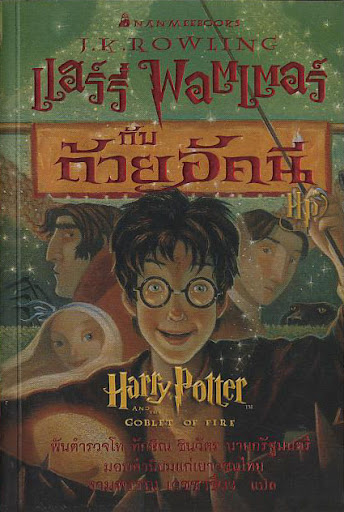
Up today is a sample from chapter 4 of Harry Potter and the Goblet of Fire, by J. K. Rowling, and its Thai translation, แฮร์รี่ พอตเตอร์ กับถ้วยอัคนี, translated by งามพรรณ เวชชาชีวะ (Ngarmpun 'Jane' Vejjajiva). Some readers may recognize the translator's name as the author of ความสุขของกะทิ 'The Happiness of Kati'. (She's also the sister of Abhisit Vejjajiva, leader of Thailand's Democrat Party.)
Mr. Weasley was looking around.
นายวีสลีย์กำลังมองไปรอบ ๆ

He loved everything to do with Muggles.
เขาชอบทุกอย่างที่เกี่ยวกับมักเกิ้ล

Harry could see him itching to go and examine the television and the video recorder.
แฮร์รี่เห็นว่าเขาอยากจะไปสำรวจดูโทรทัศน์กับเครื่องบันทึกวิดีโอจะแย่อยู่แล้ว

“They run off eckeltricity, do they?” he said knowledgeably.
“พวกนี้ใช้ไฟฝ้าใช่ไหมครับ” เขาบอกอย่างรู้ดีทั้ง ๆ ที่ใช้คำว่า ‘ไฟฟ้า’ ผิด

“Ah yes, I can see the plugs. I collect plugs,” he added to Uncle Vernon.
“ใช่แล้ว ผมเห็นปลั๊กแล้ว ผมสะสมปลั๊กไฟครับ” เขาเสริมกับลุงเวอร์นอน

“And batteries.
“แล้วก็แบตเตอรี่ด้วยครับ

Got a very large collection of batteries.
ผมน่ะมีแบตเตอรี่สะสมไว้เยอะเชียวครับ

My wife thinks I’m mad, but there you are.”
ภรรยาผมหาว่าผมสติไม่ดี แต่คุณก็มีเหมือนกันนี่ครับ”

Uncle Vernon clearly thought Mr. Weasley was mad too.
เห็นได้ชัดว่าลุงเวอร์นอนคิดว่านายวีสลีย์สติไม่ดีเช่นกัน

He moved ever so slightly to the right, screening Aunt Petunia from view, as though he thought Mr. Weasley might suddenly run at them and attack.
เขาเคลื่อนตัวไปทางขวาเล็กน้อย เอาตัวบังป้าเพ็ตทูเนียไว้ ราวกับเขาคิดว่าจู่ ๆ นายวีสลีย์อาจจะพุ่งเข้าใส่และทำร้ายเอาได้

Dudley suddenly reappeared in the room.
ทันใดนั้นเอง ดัดลีย์ก็กลับเข้ามาในห้องอีกครั้ง

Harry could hear the clunk of his trunk on the stairs, and knew that the sounds had scared Dudley out of the kitchen.
แฮร์รี่ได้ยินเสียงหีบใส่ของกระแทกขั้นบันได และรู้ว่าเสียงนั้นทำให้ดัดลีย์ตกใจและออกมาจากห้องครัว

Dudley edged along the wall, gazing at Mr. Weasley with terrified eyes, and attempted to conceal himself behind his mother and father.
ดัดลีย์เดินถัดกันแนบไปกับผนังห้อง สายตาจับจ้องอยู่ที่นายวีสลีย์และพยายามไปซ่อนตัวอยู่หลังพ่อแม่

Unfortunately, Uncle Ver­non’s bulk, while sufficient to hide bony Aunt Petunia, was nowhere near enough to conceal Dudley.
โชคร้ายที่บั้นท้ายของลุงเวอร์นอนซึ่งใหญ่พอจะบังป้าเพ็ตทูเนียที่ผอมหนังหุ้มกระดูกได้นั้น ไม่มีทางจะบดบังดัดลีย์ได้เลย

“Ah, this is your cousin, is it, Harry?” said Mr. Weasley, taking another brave stab at making conversation.
“อ้อ นี่ลูกพี่ลูกน้องจองเธอใช่ไหม แฮร์รี่” นายวีสลีย์ถาม พยายามรวบรวมความกล้าอีกระลอกที่จะเริ่มการสนทนา

“Yep,” said Harry, “that’s Dudley.”
“ครับผม” แฮร์รี่ตอบอย่างยินดี “ชื่อดัดลีย์ครับ”

He and Ron exchanged glances and then quickly looked away from each other; the temptation to burst out laughing was almost overwhelming.
แฮร์รี่กับรอนสบตากันและรีบเมินมองไปคนละทาง ความรู้สึกอยากระเบิดหัวเราะออกมานั้นรุนแรงจนแทบจะกลั้นไว้ไม่ไหวแล้ว

Dudley was still clutching his bottom as though afraid it might fall off.
ดัดลีย์ยังคงกุมก้นไว้แน่นราวกับกลัวว่ามันจะร่วงหลุดลงมา

Mr. Weasley, however, seemed genuinely concerned at Dudley’s peculiar behavior.
ทว่านายวีสลีย์ดูจะเป็นกังวลกับท่าทีพิกลของดัดลีย์อย่างจริงใจ

Indeed, from the tone of his voice when he next spoke, Harry was quite sure that Mr. Weasley thought Dudley was quite as mad as the Dursleys thought he was, except that Mr. Weasley felt sympathy rather than fear.
จริงทีเดียว เมื่อฟังจากน้ำเสียงของเขาที่พูดต่อมา แฮร์รี่แน่ใจว่านายวีสลีย์คิดว่าดัดลีย์สติไม่ดีเหมือนที่พวกเดอร์สลีย์ก็คิดว่านายวีสลีย์สติไม่ดีเหมือนกัน แต่ก็แตกต่างกันตรงที่นายวีสลีย์รู้สึกเห็นอกเห็นใจดัดลีย์มากกว่าจะนึกหวาดกลัว

“Having a good holiday, Dudley?” he said kindly.
“พักร้อนสนุกไหม ดัดลีย์” เขาถามอย่างอ่อนโยน

Dudley whimpered.
ดัดลีย์ครางหงิง

Harry saw his hands tighten still harder over his massive backside.
แฮร์รี่เห็นมือของเขาบีบบั้นท้ายอันมโหฬารแน่นขึ้นอีก

Fred and George came back into the room carrying Harry’s school trunk.
เฟร็ดกับจอร์จกลับเข้ามาในห้อง พร้อมกับยกหีบใส่ของของแฮร์รี่มาด้วย

They glanced around as they entered and spotted Dudley.
ทั้งสองกวาดตามองไปรอบห้อขณะก้าวเข้ามาและสังเกตเห็นดัดลีย์

Their faces cracked into identical evil grins.
ใบหน้าของฝาแฝดฉีกยิ้มออกมาอย่างเจ้าเล่ห์แสนกลเหมือนกันไม่มีผิดเพี้ยน

“Ah, right,” said Mr. Weasley.
“เรียบร้อย” นายวีสลีย์พูด

“Better get cracking then.”
“จุดไฟเลยดีกว่าถ้างั้น”

He pushed up the sleeves of his robes and took out his wand.
เขาถลกเขนเสื้อขึ้นและหยิบไม้กายสิทธิ์ออกม

Harry saw the Dursleys draw back against the wall as one.
แฮร์รี่เห็นครอบครัวเดอร์สลีย์ถอยกรูดไปกระจุกกันอยู่ติดผนังห้อง

“Incendio!” said Mr. Weasley, pointing his wand at the hole in the wall behind him.
“อินเซนดิโอ!” นายวีสลีย์ร่ายคาถา พลางชี้ไม้กายสิทธิ์ไปยังรูโหว่ที่ผนังด้านหลังเขา

Flames rose at once in the fireplace, crackling merrily as though they had been burning for hours.
เปลวไฟลุกโชติช่วงขึ้นในเตาผิงทันที มีเสียงลูกไฟแตกเปรี๊ยะอย่างร่าเริงราวกับไฟนี้จุดมานานหลายชั่วโมงแล้ว

Mr. Weasley took a small draw­string bag from his pocket, untied it, took a pinch of the powder inside, and threw it onto the flames, which turned emerald green and roared higher than ever.
นายวีสลีย์หยิบถุงหูรูดใบเล็กออกมาจากกระเป๋าเสื้อ เปิดปากถุงออกและหยิบผงในถุงออกมาหยิบมือ ก่อนจะโยนเข้าไปในกองไฟ ทำให้ไฟกลายเป็นสีเขียวมรกตและลุกโชนสูงขึ้นกว่าปกติ
There are a number of interesting things in this passage.

Vocabulary:
Here are a few words you may have learned:
  • (magic) wand = ไม้กายสิทธิ์ /máai kaay-ya-sìt/ (กายสิทธิ์, referring to an object, means to be enchanted, or to have magical properties; for example, there's an old 70s Thai movie called อัศวินดาบกายสิทธิ์ 'knight of the enchanted sword')
  • spell = คาถา /khaathǎa/
  • cast a spell = ร่ายคาถา /râai khaathǎa/ (traditionally this means to recite an incantation)
  • backside, posterior = บั้นท้าย /bân tháai/
  • drawstring bag = ถุงหูรูด /thǔŋ hǔu rûut/ (หู /hǔu/ here is the same word as 'ear', and used for things you hold onto, like หูโทรศัพท์ 'telephone receiver', หูจับ 'handle', หูถุง 'bag/sack handle(s)', etc.)
Granted, not all of it is the most useful vocabulary. But this is why it's so critical to read in Thai (or whatever language you study). It allows you to find and digest the less common vocabulary that would otherwise go over your head if you heard it in passing, or in a movie or somewhere.

Transcription: Notice where the translator chooses to use ทับศัพท์ /tháp sàp/ (transcribed words). Words like Muggle (มักเกิ้ล), proper names (แฮร์รี่, รอน, ดัดลีย์), and spell names (อินเซนดิโอ), for example. Simple transcription of proper names is pretty much a given (though not in, say, Chinese, where a little more creativity is involved). But for "Potterisms" like Muggle (an ordinary, non-magical person) or the spell names, the translator might just as well have come up with translations.

Wordplay:
There's one instance of word play in this passage (which is part of why I chose it). The character Mr. Weasley is a wizard who is obsessed with non-wizard things, like electricity. But to show how he thinks he knows more than he actually does, the author has him mispronounce 'electricity' as 'eckeltricity'. In the Thai, Mr. Weasley mispronounces the tone of the Thai word for electricity, ไฟฟ้า /fai fáa/, as ไฟฝ้า /fai fâa/.

However, an explanatory note is also given in Thai. Apparently they're worried the reader would miss the joke and think it was a typo (I'm assuming this is exactly what happened when an editor read the draft translation). The English just says "...he said knowledgeably." Its Thai equivalent translates to "...he said knowledgeably, even though he had used the word 'electricity' wrong". Wouldn't want the mispronounced version to become hip new slang! :P

Mistranslations:
Inevitably, there are things which the translator will not pick up on. Shades of meaning that native speakers pick up on. But sometimes it's hard to decide what exactly is a mistranslation.

Here's one I think is mistranslated, though:
My wife thinks I’m mad, but there you are.”
ภรรยาผมหาว่าผมสติไม่ดี แต่คุณก็มีเหมือนกันนี่ครับ”
The phrase 'but there you are' is an idiom (more of a Britishism, I'd say) that means 'but so it goes' or 'but that's just how it is'. Here she has translated it as 'but you have (a large battery collection) too.' Which doesn't make any sense at all, sense it's meant to be comical that Mr. Weasley doesn't realize most Muggles would find it strange to have a battery collection. What might have gone here instead--perhaps แต่ก็ยังงั้นแหละ or something similar.

And here's one that at first I thought was wrong, but is probably intentional:
“Better get cracking then.”
“จุดไฟเลยดีกว่าถ้างั้น”
The Thai literally means 'Better start the fire then.' (This is a method of wizard travel in the Harry Potter universe.) Of course, 'get cracking' is an English idiom meaning 'begin, begin without delay'. In this context Mr. Weasley means they should go.

At first glance I thought the translator had misunderstood 'cracking' as 'crackling', referring to the crackling flames of a fire. But after thinking about it, there's not a way to directly translate the idiom. So the translator has chosen to specify the implied action. The word เลย helps retain the meaning of 'immediately, without delay'. It seems to fit the Thai better, too.

Translation is a complex and difficult venture, to say the least. What strikes you as interesting about this text?

August 7, 2008

Resources on Thai word origin and usage

There are a number of books and book series that follow a similar format: short chapters, each one devoted to a single Thai word or small set of words. I'm talking about these books that discuss the origin and usage of Thai words.
  
Many are compiled from other media into book form (radio or tv shows, newspaper or magazine columns). I have a whole slew of books like these. And a lot of the material can be had for free online. Notable series include:

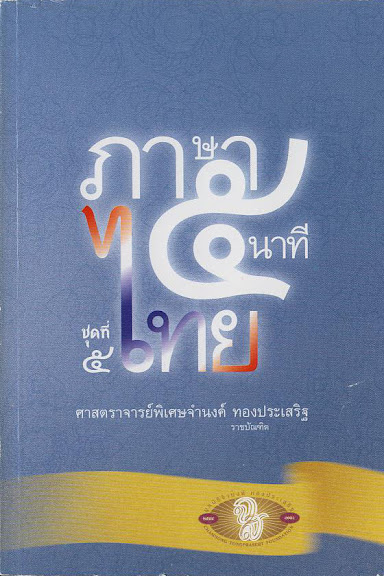
ภาษาไทย ๕ นาที by จำนงค์ ทองประเสริฐ
The title means '5 Minutes of Thai Language'. This series is up to volume 9 now. I own 3 and 5, I believe. They consist of transcripts from Prof. Chamnong's long-running five-minute radio show of the same name. I'm not sure if it's still on the air, but I don't think so.

A fellow of the Royal Institute who has held pretty much every position of leadership in that organization over the years. The good professor is in his seventies, but still active at the Royal Institute, as far as I know. I interviewed him for my senior thesis back in 2005.

About 150 transcripts are freely available on Prof. Chamnong's website (note: that link goes to page 1 of 3, so be sure not to miss the full set of available articles). I believe this represents the full contents of vol. 3, possibly more.

ภาษาไทยวันละึคำ by กาญจนา นาคสกุล
"Thai language, A Word a Day" was a recurring five-minute television spot which ran for several years in the early 90s, I believe. Transcripts from each broadcast year have been published, as you can see from this book cover here. Last year a hardcover compendium called ภาษาไทยวันละคำ ฉบับรวมเล่ม was released, compiling the show's entire run into one big (800+ page), alphabetized volume.

Dr. Karnchana is also a fellow of the Royal Institute. When I interviewed her in 2005, she was one of the two vice-presidents of the Royal Institute. Her term of service in that position may be up by now, but she's still active in the Royal Institute, and was in the news last year for spearheading the พจนานุกรมคำใหม่ 'Dictionary of New Words' project at the Royal Institute.

She also has a semi-regular column called ภาษาไทยวันนี้ 'Thai Language Today' in the weekly magazine สกุลไทย that has run since 2000. You can access the archives on Sakulthai.com, totaling nearly 200 columns.

ภาษาไทยวันนี้ by สมพร จารุนัฏ
Although it shares a name with Dr. Karnchana's column, I don't think there is any relation with this series of books published by the Ministry of Education.

The MOE has a website (unfortunately offline right now) on which you can view and download hundreds of their textbooks in PDF format for free, these books included, among dozens of other Thai-language textbooks ranging from grade 1 through grade 12. This is the first time I've tried to visit the site in a while, so hopefully it's not offline permanently. Excellent little website with more free books than you can shake a stick at.

There are other series and other individual volumes. ภาษาไทยนอกจอ, ภาษาคาใจ (3 volumes), ภาษาไทยไขขาน (half a dozen or more, I think--also by Dr. Chamnong), others. I'm also a fan of the column มองไทยใหม่ 'A New Look at Thai' by นิตยา กาญจนะวรรณ, which runs weekly in มติชนสุดสปัดาห์ (Matichon Weekend). Several compilations of Dr. Nitaya's articles have been published but are now out of print. You used to be able to get all of the back-issues of her column for free on Matichon's website, but now you have to be a paying customer (not to paying customers: read her column).

One of the Royal Institute's present initiatives to "improve" the public's use of the Thai language is a radio show called รู้ รัก ภาษาไทย 'Know and Love the Thai Language'. Transcripts are regularly updated on their website here. You can also check out other compiled articles on language (among other topics) on this page of their site. Many of these were written by Prof. Chamong and Dr. Karnchana, so there may be some overlap with other books. I've never checked. But there are hundreds of articles to peruse.

There's a ton of material out there, and much of it free. If you know of any other resources, online or book, please post a comment or drop me an email (my address is at the bottom of the blog).

Etymologist 15: Ghosts and butterflies

I found another connection that is shared between multiple Southeast Asian languages: use of a word for 'spirit' or 'ghost' in the word for 'butterfly'.

In Thai the word for 'butterfly' is ผีเสื้อ /phǐi sɨ̂a/. The first syllable is the common Thai word for 'ghost'. The second word is the word for 'shirt', but I suspect that may be a coincidence, and the เสื้อ in ผีเสื้อ doesn't actually have to do with shirts. But I don't know for sure one way or the other.

In Mon, the word is /kəlok həlɛ̀a/, where /kəlok/ means 'Spirit, daemon', and /həlɛ̀a/ means 'Indian' (i.e. a native of India), from the Burmese ကုလား  /kəlá/ (comparable in meaning to Thai แขก, although probably cognate with Thai กุลา). [Data from Harry Shorto's 1962 A Dictionary of Modern Spoken Mon.]

In Burmese, the word for 'butterfly' is လိပ်ပြာ /leiʔ pyà/. This is also the word for spirit (corresponding in meaning to Thai วิญญาณ 'spirit', not ผี 'ghost', but the ideas are connected). [Data from SEAlang. You can download Burmese fonts at that link.]

So again we see a case where although the words are completely different, a very similar semantic concept appears in these neighboring cultures. I checked in Khmer and a few other dictionaries, and I didn't notice this in any other Southeast Asian languages.

It's an interesting question to ponder: why the connection between butterflies and supernatural spirits? Any thoughts?

August 2, 2008

Should we fork or spoon? Musings on ช้อนส้อม

So here's something straight from my dinner table: when is a spoon not a spoon? When it's a fork, apparently.

On a couple of recent occasions now, I've been getting things ready at dinner time and found I'd forgotten to bring eating utensils with me to the table. Thai meals generally call for a fork and a spoon. So if my wife happened to be standing near the silverware, I would ask her to grab me ช้อนส้อม. Both times she brought me only a fork. And both times she's said, "You only asked for a fork."

Turns out, to her, ช้อนส้อม means 'fork'. If we break it down, ช้อน = spoon and ส้อม = fork.

There are a number of fixed phrases in Thai where adjoining two nouns creates a new coordinate noun, without the need to use the conjunction and. You see it phrases like:
  • พ่อแม่ 'parents' (literally 'dad + mom')
  • พี่น้อง 'siblings' (literally 'older sibling + younger sibling')
  • สามีภรรยา 'husband and wife' (literally 'husband + wife')
  • ปู่ย่าตายาย 'grandparents' (literally 'paternal grandfather + paternal grandmother + maternal grandfather + maternal grandmother')
  • เสื้อผ้า 'clothes' (literally 'shirt + cloth') 
  • วัวควาย 'livestock' (literally 'cow + buffalo')
So I always thought ช้อนส้อม worked the same way. But not so with my wife. I must be sure to ask for fork and spoon (mandatory conjunction, in thise case กับ = 'and'). She has been surprised that I don't know this, either.

And that's fine, of course. There's lots I don't know. But looking on the internet, there's no shortage of evidence that ช้อนส้อม is used to mean both fork and spoon. And ชุดช้อนส้อม can mean a fork-spoon pair, or the entire cutlery set (sometimes including a knife, sometimes multiple forks or spoons).

There's textual evidence, too. Clauses like ถ้าหากว่าช้อนส้อมคู่ไหนเริ่มเก่า "If any fork and spoon pair begins to get old..."

None of this is to say that I doubt my wife's knowledge of her own native language. I just don't really know if her usage is widespread or not. She's Bangkok born and raised.

If we analyze how ช้อนส้อม can mean just 'fork', we could say that fork is part of the class of things called ช้อน, where we have ช้อนชา 'teaspoon', ช้อนโต๊ะ 'tablespoon', ช้อนกลาง 'serving spoon', and ช้อนส้อม 'fork'.

Which raises the most important question of all: what on earth are we going to call sporks when they finally arrive in Thailand? Maybe ส้อมช้อน? I don't think ช้อม or ส้อน will go over well. (Note to self: invest in sporks.. those things are gonna be huge here some day.)

Readers, please makes this query of the nearest Thai person: If I ask you to bring me ช้อนส้อม, are you going to bring me a fork, a spoon, or both?