January 17, 2008

Know Your Dictionary: Word Senses in RID99

[Note: See also in this series introduction, sorting, orthography, symbols, and pronunciation guides. Forthcoming: etymology and list of abbreviations.]

For this installment of Know Your Dictionary we have the section called
simply "ความหมาย" in the original introduction to Royal Institute Dictionary 1999 (พจนานุกรม ฉบับราชบัณฑิตยสถาน พ.ศ. ๒๕๔๒). Now, ความหมาย means "meaning(s)". However, I decided to go with the word "sense" because it's commonly used in a dictionary context to refer to distinct meanings of an entry. Also, sometimes RID99's use of sense or meaning (ความหมาย) vs. definition (บทนิยาม) doesn't perfectly match how I would use them in English. As in other installments, I have tried to translate closely and consistently, but I may have made a few concessions for style. (You can read the original Thai here.)

Part 5:
Word senses
1. In defining words with many senses, definitions that are constantly used and are thought to have prominent meanings are normally ordered first. But there are some exceptions where it is intended to show the history of senses, in which case the sense that is thought to be the original sense might be first, followed by the origin, opposites, or collocates (if there are any). Effort has been made to give specific examples for uncommon words.

2. For words with numerous senses that include plant or animal names, definitions of plants and animal names are separated from other definitions, by elevating that word as a separate headword, see for example แก้ว.

3. Abbreviations in parentheses tell the characteristics of a word used in a specific context, e.g. (โบ) (แบบ) (กฎ). If it comes before the part of speech, that means that every definition is used on only in the context specified in parentheses, e.g. เข้า ๒ (โบ) น. ข้าว; ขวบปี. If it comes after the part of speech, only the definitions before the semicolon are used in the context specified in parentheses, e.g. ข้าราชการ น. (โบ) คนที่ทำราชการ ตามทำเนียบ; ผู้ปฏิบัติราชการในส่วนราชการ;...

4. Words that are the plant and animal names follow these definition rules:
A. Plants from different families with the same name are defined under the same headword, but are differentiated by a number in parentheses, e.g. กระโดงแดง น. (๑) ชื่อไม้ต้นขนาดใหญ่... (๒) ชื่อไม้ต้นขนาดกลาง ...

B. Animals with the same name that are the same type of animal, but are from different species or families, are defined under the same headword, but separated by a number in parentheses, e.g. กด ๒ น. (๑) ชื่อปลาไม่มีเกล็ด ... (๒) ชื่อปลาน้ำจืดบางชนิด ...

C. Animals with the same name but are a different type of animal are not defined under the same headword, but are given different headwords by type along with separate definitions. See for example แก้ว and จะละเม็ด.


5. Inclusion of sub-entries of plant and animal names follows these rules:
A. Sub-entries of plants or animals are of the same family as the headword, e.g. กระโดน has the subhead กระโดนดิน, which is a plant of the same family, or, หมอ ๓ has the subhead หมอตาล, which is an animal of the same family.

B. If a plant or animal name is a class term for plants or animals with similar features of many species or many families, sub-entries must have a meaning related to the headword, which may be of a different species or family from the headword, e.g. จันทน์ has the subheads จันทน์กะพ้อ, จันทน์ขาว, จันทน์ชะมด, etc., or, เขียว ๓ has the subhead เขียวหางไหม้.

From point 1 we learn about sense ordering. This is important because dictionaries generally fall into one of two camps: historical order or frequency order. In the first camp, senses are ordered by earliest known text citation (OED, for example); in the second camp, the most commonly used senses are listed first. We learn that RID is a mix of both. I'm not sure how common this type of organization is, but I find it distressing because so far as I know there is no way to know which is which. We can't assume one or the other without some kind of notation. So as I see it, this boils down to mean that, unfortunately, there is not a ton we can learn from sense ordering in RID99. If the first sense is a commonly used sense, it's probably safe to assume that they are ordered by (rough) frequency. Unfortunately again, I don't think there is any empirical evidence behind their ordering, so even the frequency ordering is probably based only on the sense of the committee members as to which words are more common.

The rest is mostly explanation of notation, which is useful. Like how to interpret the scope of a given usage note based on surrounding punctuation (see point 3), or the genetic relationships of certain flora and fauna with their sub-entries.

January 13, 2008

Thai standup: 21st Century comedy!

While I enjoyed the homecooked 19th Century comedic goodness of my last post, I thought I'd give us a little push into the present century with some help from YouTube. User aanon2550 (who posts as user aanon on the Thai language forum at thaivisa.com) has done English translations for three videos by Thai comedian Note Udom โน๊ต อุดม (อุดม แต้พาณิช). aanon knows his Thai, and the videos are a lot of fun. There is also plenty more of Note's material on YouTube, but I figured I'd post the ones with the English subtitles.

The second two appear to be from other TV appearances, but the first video is apparently from one of Note's series of standup comedy specials. The term for standup comedy in Thai is เดี่ยวไมโครโฟน, which literally means "microphone solo". As opposed to the concept of a standup club where people can come anytime and see different comics, shows here tend to be periodic, but bigger deals held in larger venues. Note has these periodic sell-out events where he packs the place, and then sells the video of the show on VCD. He seems to be extremely well-known and popular, and has been for a while. A few years ago I ran into him at the mall, but had no idea who he was at the time--the Thai friend I was with got his autograph, though. He just did his seventh standup show this past December. You can learn more about him at his website, udomteam.com. Enjoy.

Video 1: แฟนบอกเลิก


Video 2: ศาลพระภูมิ


Video 3: ต้นงิ้ว

January 9, 2008

Old News: 19th Century comedy!

I've found a fun piece from the Bangkok Recorder to share today. I think it was published as filler, because it's a short humorous anecdote that ran on the inside of the back page of the issue, the least important page of a newspaper. Kind of like the forerunner to Reader's Digest using jokes to fill in the space after articles, I guess.

As with the last two installments of Old News, it was first published on November 3, 1865.

A mild warning
ความเตือนอันอ่อน
ครั้งก่อนมีขุนนางผู้ใหญ่, ได้นั่งกินโตะด้วยกันกับคนอื่นมากนั่งแน่นกันนัก. มีคนหนึ่งที่พูดมาก ๆ นั่งใกล้กันกับคนนั้น. คนที่พูดมากนั้น, ครั้นพูดแล้วก็ยกมือไปมาตามคำที่เขาพูดด้วย. ขุนนางนั้นจึ่งบอกกับเขานั้นว่า, มือของท่านเปนเครื่องรำคาญใจข้าพเจ้านัก. คนนั้นจึงตอบว่า, ขอรับกระผมคนแน่นมาก, เกล้าผมไม่รู้ที่จะเอาไว้ที่ไหนได้, ขุนนางนั้นจึ่งตอบว่า, ถ้าอย่างนั้น ก็เอามือยัดไว้ในปากเสียเถิด.
And my translation:
A mild warning
Once an important nobleman was having a meal with many other people, all crammed around the table. One person sitting near him was talking nonstop. When the man was speaking he would wave his arms about along with his words. So the nobleman said to him, "Your hands are an annoyance to me." The man replied, "my lord, the table is so crowded that I don't know where to put them!" The nobleman thus replied, "If that's the case, then stick them in your mouth!"
As far as I know, Dan Beach Bradley wrote (or often translated) the entire contents of the newspaper, which makes me wonder if this joke isn't translated from some Western source. It strikes me as vaguely familiar, but I can't place it. Has anyone heard a story similar to this in English?

Something interesting to notice about the language usage:
The pronoun เกล้าผม. Many Thai higher-register pronouns (those used to show respect to superiors) comes from words that refer to either the head (as in this case) or the feet (as in ใต้เท้า). As I understand it, เกล้าผม makes reference to the topknot that was historically worn at the apex of the head by children (until ceremonially cut). But it's particularly interesting to see it in the same sentence with กระผม. I had previously wondered about the origin of กระผม, and considered the possibility that it is a phonologically reduced form of เกล้าผม. This example shows how both are used as honorific pronouns, and they seem to be interchange, but the fact that they both show up in the same sentence may be evidence against my little theory. RID99 includes an entry for เกล้ากระผม, a hybrid of these two, but we need a lot more textual evidence before we can clearly lay out the order of origin for the different versions. (Incidentally, this connection with the head demonstrates that it's no coincidence that ผม means both "hair" and "I". The meaning "hair" undoubtedly came first, and gave rise to the respectful pronoun.)

January 7, 2008

Book review: A Physician at the Court of Siam

A few days ago I finished reading A Physician at the Court of Siam by Malcolm Smith (Oxford in Asia Paperbacks, 1985, 164 pages). First published in 1946, it's gone out of print, but I picked up a used copy on Amazon a while back. Took me almost two years to get around to reading it. I'm glad I finally made the time.

Malcolm Smith served as a court doctor for Queen Saowapa Pongsi
(พระองค์เจ้าเสาวภาผ่องศรี, alternately spelled Saovabha Bhongsi), one of the four royal consorts of King Chulalongkorn, and mother to Kings Vajiravudh and Prajadhipok (Ramas VI and VII), and thus he has some extremely unique and rare insights into palace life during his time in the country's history. Smith arrived in Siam in 1905, and maintained a private practice outside of the palace in Bangkok while constantly being on call for the Queen. After Rama V passed away in 1910, Saowapa became Queen Mother, and she retained Dr. Smith as her physician in an unofficial capacity until her death in 1919.

If Smith's account concerned only his years in Siam, it would be of great value. But he combines his personal account with a great deal of research, particularly on the history of the Chakri Dynasty, in addition to the period of his own experiences. The main character in many ways is Queen Saowapa, as she is the member of the royal household whom Smith came to know best. He writes of her eccentricities in a fascinating level of detail and candor. The book reads very quickly, and fortunately lacking much of the ethnocentrism of so many earlier Western accounts. While one can tell that Smith views the typical Southeast Asian laid back attitude towards work and efficiency with a predictable Western distaste, he has enough objectivity (and perhaps enough distance, writing the book many years after leaving Siam), to avoid treading too far into "noble savage" territory like so many of the early Westerners in Siam who have left us their stories to read. And since he did not travel to Thailand as a missionary, his account makes nary a reference to religion at all. So we are spared the supplications (so typical in early Western accounts) for the expeditious redemption of the ignorance-shrouded, hell-bound souls of the heathen Siamese.

This book is perhaps unlike any other in its details of Siamese court life, excepting Anna Leonowens' An English Governess at the Court of Siam, the book (presented as fact but mixed with plenty of fiction) which formed the basis for Margaret Landon's 1942 book Anna and the King of Siam (even looser with the facts), which became further distorted in the 1946 film of the same name, and again into the cartoonish
(if not unenjoyable) Broadway musical and film The King and I and finally culminating in the utterly preposterous 1999 endeavor Anna and the King. Smith seems to be the more neutral and thus reliable source. He even gets in a mild dig at Leonowens (keep in mind they were not contemporaries--she arrived in Thailand 40 years before he did). He writes of her unflattering portrayal of King Mongkut, "we need not believe all that she said; her books, particularly her second one [Romance of the Harem], show that she was gifted with a vivid imagination which at times took charge of her pen" (p. 42).

Much of Leonowens' negative portrayal of the monarch's private life stems from her extreme displeasure with polygamy. On this point Leonowens and Smith could not disagree more. In fact, Smith goes so far as to include a chapter in his book defending the practice in turn-of-the-twentieth-century Siam. He examines the hyperbolic estimates
by what he terms "irresponsible" writers of the size of the Siamese kings' harems, and compares those estimates with the official chronicle to debunk them as uninformed. He also makes an attempt to defend the inbreeding, ahem, "consanguineous marriage" practiced in the Siamese royal family, as in many a royal family worldwide (his employer Queen Saowapa was the half-sister of her husband King Chulalongkorn--children of King Mongkut by different wives). Smith's take on these issues makes for a compelling alternate perspective, even if his defensiveness struck me as odd.

In all, I recommend Smith's book as a quick read that will easily sustain the interest of anyone with the slightest inclination for Thai history.

My typical modus operandi for selecting new reading material is to start several books at once. Right now I've started National Identity and its Defenders: Thailand Today, edited by Craig J. Reynolds, a collection of articles on the shaping and maintenance of the Thai national culture and identity which is already turning out to be utterly fascinating; Mo Bradley and Thailand, by Donald C. Lord, a book of ever-increasing rarity about Dan Beach Bradley (of Bangkok Recorder and first Thai-Thai dictionary fame); and Siam Mapped: A History of the Geo-Body of a Nation, which has been recommended to me by a couple of people. It remains to be seen which will succeed in drawing me in before the others.

If you have any book recommendations, please leave a comment, or write me at the email address at the bottom of the page.

January 5, 2008

Know Your Dictionary: Pronunciation Guides in RID99

[Note: See also in this series introduction, sorting, orthography, symbols, and word senses. Forthcoming: etymology and list of abbreviations.]

I'm back again with another installment in the Know Your Dictionary series, in which I am translating the introduction to the Royal Institute Dictionary, 1999 Edition. The remaining installments will be coming down the pipeline quickly. They're all translated, but I've been staggering them to avoid entirely chasing away readers who prefer less, ahem, arcane topics. The original Thai for this translation is here.

Part 4: Pronunciation guides

Pronunciation guides follow these rules:
1. Words that end with the basic final consonants, e.g. แม่กน* spelled with น, แม่กบ spelled with บ, as in the words คน or พบ, are not given a pronunciation guide.

2. Words with ญ ณ ร ล ฬ pronounced like น, words with ข ค ฆ pronounced like ก, words with จ ช ฎ ฏ ฐ ฑ ฒ ต ถ ท ธ ศ ษ ส pronounced like ด, words with ป พ ฟ ภ pronounced like บ--all four types are given pronunciation guides if the spelling causes ambiguous pronunciation.

3. Pali and Sanskrit words that are samasa (สมาส) compounds must usually be pronounced according to compounding rules, i.e. pronouncing the final syllable with a compound อะ vowel; this type of word is given a pronunciation guide, e.g. ทารุณกรรม [ทารุนนะกำ], สุขนาฏกรรม [สุกขะนาดตะกำ], รูปธรรม [รูบปะทำ]. For words which have developed two pronunciations, i.e. a rule pronunciation and a popular pronunciation, the rule pronunciation is given first, e.g. ประวัติศาสตร์ [ปฺระหฺวัดติสาด, ปฺระหฺวัดสาด], มัธยมศึกษา [มัดทะยมมะ-, มัดทะยม-], อุดมการณ์ [อุดมมะ-, อุดม-].

4. Pronunciations with the phinthu (พินทุ) dot beneath a letter means either:
A. That letter is a "leading letter" and is not pronounced, i.e. a phinthu dot is placed below ห to prevent alternate pronunciations that have different meanings, e.g. เหลา [เหฺลา], เหย [เหฺย], แหงน [แหฺงน].
B. That letter is part of a consonant cluster, which there are three of in Thai, i.e. ร ล ว; the phinthu dot is placed below the first letter of the cluster to cause the two consonants to be read as a cluster, e.g. ไพร [ไพฺร], ปลอบ [ปฺลอบ], กว่า [กฺว่า].

5. Words from other languages which formerly were pronounced with consonant clusters and when borrowed into Thai are pronounced as two syllables are given Thai pronunciation guides, e.g. เสด็จ [สะเด็ด], พยาบาท [พะยาบาด], แสตมป์ [สะแตม].

6. For sub-entries with possibly ambiguous pronunciation because the pronunciation is not the same as that of the headword, a pronunciation guide is given for the sub-entry, e.g. กล, กล- [กน, กนละ- ] น. ... กลไก [กน-] น. ... กลฉ้อฉล [กน-] น. ... กลบท [กนละบด] น. ...
To be honest, I have trouble understanding why the Royal Institute doesn't do a better job with pronunciation guides in their dictionary. It betrays the underlying assumption that anything significant in the pronunciation of a Thai word can be captured by the existing orthography. But this ignores some important things. Among them:

1. Syllable stress. This can be non-transparent in compounds, so it should be made explicit.

2. Vowels written long but pronounced short (for example, เส้น is short but เสน is long; แห่ง is short but แห้ง is long. While there is a regular pattern to this sort of thing, their approach assumes the reader inherently knows this, but this isn't obvious and rarely taught to second-language learners.

3. Words with short vowels but no final glottal stop. For example, the particle นะ, among others. Compare with ณ, which has a final glottal stop, and you'll see what I mean. This is also important because some words must always be pronounced with a glottal stop, in both careful and fast speech (e.g. สะใจ), while huge numbers of words lose their glottal stops in normal/fast speech or in compounds, but not always predictably so (e.g. สาระ--yes glottal vs. สารพัด--no glottal vs. สารสนเทศ--yes glottal). It's time for a publication as venerated as RID to start differentiating. Assuming users know the right answer is not the answer.

In English dictionaries, for as long as I've been using them (that's my cop-out way of saying I don't know when this innovation was introduced), the basic alphabet has to be augmented in order to systematically represent all of the sounds possible in the language. Lexicographers of English use breves and macrons and other diacritics and punctuation to try to best represent the spoken language on paper. RID gets away with using only the พินทุ (the little dot placed below a letter to indicate a consonant cluster). Unfortunately, that doesn't really cut it. It's in instances like this that it's clear that RID is intended for native users. I'm sure the scholars at the Royal Institute could devise a better system using Thai orthography. And it's okay if it takes users some learning to be able to interpret. I remember often having to flip to pronunciation guide on the inside front cover of my old Merriam-Webster Collegiate as a kid to check if a certain symbol stood for a as in father or a as in cat. Nothing invested, nothing gained.

Well, enough of my cranky ranting. If you can think of any other insights into the RID's system, leave a comment. Tune in next time for the section about word senses. Before that, though, I have a couple of gems from the Bangkok Recorder to share, in the long-awaited (by me, if no one else) return of the feature Old News [see previous installments of Old News about Siam's first advertising and the original Siamese twins].


*This format of แม่ X (แม่กก แม่กง แม่กน แม่กด etc.) is used in schools to teach Thai children about which final consonants make what sound. So แม่กด consists of words ending with ด ต ท ถ, and so forth). It's difficult to succinctly translate, but when it says "
แม่กน spelled with น" what it means is final consonants that are pronounced น that are also spelled with น. I chose to translate this concept as the "words that end in the basic final consonants".

January 4, 2008

New "Life of Buddha" animated film misses the point

There is a rather scathing review of the new Thai animated film The Life of Buddha over at Prachathai. In the review, Pali scholar Eisel Mazard points out both its anachronisms (for example, the Buddha is seen reading a manuscript written in Khmer, and he is portrayed as having no female monastic followers) and its flat out failure to portray any of the actually meaningful events in the life of the Buddha, instead focusing on his "magic" abilities. Says Mazard:
He evidently never said, wrote, or recited anything of philosophic significance, and is instead an object of worship simply on account of his (supposed) royal blood and conjurer's tricks.
These are harsh words, and although I haven't seen the film, this state of affairs doesn't surprise me. There is much that is elegant and profound in the theodicy, cosmogony, and other philosophies of Buddhism. But as the recent จตุคาม (Jatukam) amulet fad--gone as quickly as it came--shows us, so very little of it penetrates the everyday lives of the masses of a supposedly Buddhist nation, who adhere more to ไสยศาสตร์ folk traditions and หมอดู fortune tellers.

Mazard has no shortage of vitriol for this film. He goes on:
The film is garbage; however, the monks and laypeople that now step forward in praise of it (as an accurate depiction of the historical Buddha) do us a great favor in discrediting themselves.
And he finally concludes:
There was (and is) "a point" and "a plot" to the Pali canon; and it's a shame that both the film-makers, and so much of the Thai audience, simply miss the point.
Does this film indicate that Thailand is forgetting why the Buddha became a significant historical figure in the first place? Anymore, is he worshipped merely for worshipping's sake?

That it turned out this way is ironic, if not sad, as it appears to have been the passion project of its primary funder, Thai businesswoman Wallapa Phimtong. After numerous setbacks, she reportedly had to sell off her cars, land and other assets to cover the more than 100 million baht
price tag of the project.

If the email forwards that I've seen going around are any indication, the film, which opened a month ago on the King's 80th birthday, hasn't done well. The email I received from well-meaning acquaintances urges everyone to go see this upstanding and moral film so that it doesn't get pulled from theaters. I agree with the sentiment--good films deserve to be watched so that more good films can be made. But if the movie is this poorly executed, perhaps the fact that it's an apparent box office bomb might be interpreted as a good sign for the state of Buddhism in Thailand. But I don't think so, and Bangkok Post film critic Kong Rithdee would seem to agree:
"[The film] mirrors the national climate of institutional worship and the indifference, if not the ignorance, to how modern society has twisted Lord Buddha's teachings into something much less pure than their original meanings."
Perhaps I'll go consult my fortune teller now about which day is most auspicious to go see this movie.

January 2, 2008

Etymologist 12: Is it 'too late' to learn the truth about ทุเรศ?

Folk etymologies are an interesting phenomenon. It's a natural human impulse to want to assign meaning and order to the world around us, and this extends to language. Yet language is extremely dynamic, endlessly evolving, constantly changing. We tend to lack the long-term perspective necessary to make sense of it all. And yet we attempt to find reason within our limited frame of knowledge, and manage to come up with explanations. Sometimes good, sometimes bad. Simply put, a folk etymology is a false conception of the origin of a word or phrase.

There's always some logic behind a folk etymology, though. It has to be plausible. For example, if I claimed that the expression 'groovy' was invented by Lord Zorgath, emperor of the planet Yaxelblurg, because he had an obsession with vinyl records and considered their grooved surface the pinnacle of aesthetic advancement, you'd likely have the nice young men in their clean white coats come to take me away. But if I told you that the money given to someone as a gratuity for some service is called a 'tip' because it comes from the phrase 'to insure promptness,' well, you just might believe me (but don't--it's another folk etymology).

In English, competing folk etymologies abound. The globally ubiquitous expression 'OK' is perhaps foremost in sheer number of dubious claims of origin, but expressions like "mind your Ps and Qs", and the curse words that begin with f and sh respectively have plenty of colorful stories purporting to capture their true origins, too.

Muc
h of the time, the true etymology of a word is just plain boring by comparison. And as it happens, most folks don't know the details of sound changes and semantic shifts and derivations and inflections that drive language change. So folk etymologies are born. Someone wonders about the origin of this word or that phrase, and comes up with what seems like a logical story. And even in the face of linguistic evidence, people may still want to believe the more interesting version. So folk etymologies persist.

It's no surprise, then, that Thai has folk etymologies, just like English. One I've heard is for the word ทุเรศ. A quick check in RID99 returns this definition:
ทุเรศ (ปาก) คําพูดแสดงความรู้สึกเมื่อประสบสิ่งที่ขัดหูขัดตาหรือเป็นที่น่าสมเพชเป็นต้น.

/thureet/ colloq. An expression to show the feeling of when one experiences something displeasing, or deplorable, etc.
The claim of the folk etymology is that this expression comes from the English phrase 'too late'. Now, I understand that 'too late' is used by some Thais as a way of disguising the word ทุเรศ, just like some write 'กวน teen' in place of กวนตีน. It gives it a lighthearted or humorous angle, and can help take the edge off of the word's potential impoliteness. So it's possible that some (or many) folks are only using it to be ironic or funny. Nevertheless, some attempt to claim 'too late' as the legitimate origin of the Thai word.

The claim is that Englishmen came to Siam and set up businesses which employed native Thais. These Thais were not used to the strict timekeeping of the Westerners, and so when they failed to show up to work on time they were told they were "too late" by their English-speaking bosses. The Thais heard "too late" as ทุเรศ, which came to be a term indicating disagreeable or unacceptable behavior, etc.

Nitaya Kanchanawan does a good (and very polite) job of eviscerating this theory, which she heard on TV, in her column มองไทยใหม่ in Matichon Weekly (มติชนสุดสัปดาห์, April 28, 2006, p. 76). You can read my translation of that column here, including the original Thai.

Let's take a closer look at how this folk etymology should have been debunked, and definitely should not have made it onto the Thai airwaves, especially as part of a show about preserving Thai culture, as Dr. Nitaya states in her column.

The first evidence is from the spelling. ทุเรศ looks very much like a Thai spelling of an Indic word. It's true that it does not look much like a native Thai word, but it certainly does not look like an English word. The ร does not match the l in English 'late', and the final consonant ศ is usually a sure sign of an Indic loan.

Anyone who has experience with Thai poetry and classical literature (and all Thais do during their years of compulsory education), the ending เอศ should be familiar. It is one of the optional endings which can be compounded with a root to create a poetic version of a word, maintaining the original meaning. This would be done either for rhythm or rhyme's sake. This sort of compounding for the sake of rhyme is referred to as เข้าลิลิต, and in the case of the suffix เอศ, it's called เติม ศ. เข้าลิลิต.

I've translated a passage explaining this poetic device from this site:
เติม ศ. เข้าลิลิต refers to appending the -อีศ (SKT īśa) to the end of a word without changing the meaning, for the benefit of composition, e.g. to increase the number of syllables, or to give a word a low tone (in fact, it usually results in a falling tone, but since it is a dead syllable, it can be used in place of a low tone), or to make a heavy syllable [i.e. a syllable with a long vowel or final consonant], as needed.
The Sanskrit īśa becomes Thai เอศ, for example, Sanskrit kamala- īśa becomes Thai /ka-ma-lê:t/ (กมล + เอศ = กมเลศ).

This is a clear model for ทุเรศ to follow, which we would expect to be made up of ทุร- and เอศ. And what do you know! RID99 quickly gives up the likely culprit:
ทุร- [ทุระ-] ว. คําประกอบหน้าคําศัพท์ หมายความว่า ชั่ว, ยาก, ลําบาก, น้อย, ไม่มี, เช่น ทุรค ว่า ที่ไปถึงยาก, ทางลําบาก. (ส.).

/thura-/ adj. A prefix meaning evil, hard, difficult, few, none, e.g. ทุรค 'a place difficult to reach, a difficult path' (Skt.).
This fits the meaning of modern ทุเรศ quite well. It's seen in compounds like ทุรกันดาร (as in ถิ่นทุรกันดาร 'wasteland'), and is the etymological sibling of the prefix ทร- (as in ทรราช 'tyrant', ทรยศ 'betray', ทรมาน 'torture'). The semantic connection with the modern colloquial usage of ทุเรศ is clear enough.

The second line of evidence is text citations. RID99 falls short on this particular entry, even failing to note the word's Indic origin. Fortunately, Matichon Dictionary comes to the rescue:

ทุเรศ ว. ยาก, ลำบาก, เช่น เราแจ้งทางทุเรศเขตอรัญ สัตตภัณฑ์คั่นสมุทรใสสี (กากี). ก. หลีกลี้ไปไกล, ไปห่างไกล, เช่น หมู่สุบรรณพันโกฏิในสิมพลี ทฤษฎีแล้วทุเรศจากสถาน (สมบัติอมรินทร์). (ปาก) ว. อุจาด; คำพูดแสดงความรู้สึกว่าสิ่งนั้นๆ บุคคลนั้นๆ หรือการกระทำนั้นๆ เป็นที่น่าสมเพชหรือขัดหูขัดตา.

/thureet/ adj. Difficult, troublesome, e.g. เราแจ้งทางทุเรศเขตอรัญ สัตตภัณฑ์คั่นสมุทรใสสี (กากี). v. flee far away, go far away, e.g. หมู่สุบรรณพันโกฏิในสิมพลี ทฤษฎีแล้วทุเรศจากสถาน (สมบัติอมรินทร์). (colloq.) adj. disgusting; an expression to show the feeling that a thing or person or action is deplorable or displeasing.
Matichon includes two citations, both dating from the reign of Rama I (1782-1809). The nails are starting to go into the coffin of this folk etymology. From these citations alone it becomes utterly unlikely that a well-formed Thai poeticism would have anything to do with English, but indulge me in eliminating any possibility.

The earliest contact of British traders with Siam that I can find record of is a meeting of Captain William Keeling of the East India Company with an ambassador of Siam at the Javanese city of Bantam in 1608*. This doesn't yet approach setting up businesses and hiring Thai employees on Siamese soil, but we can confidently say that there was no possibility of such a situation taking place with English speakers prior to 1608. A citation of ทุเรศ prior to 1608 should close the case on the origin of this phrase. And Dr. Nitaya is the one who provides it, from the same article linked above:
If we go back to the time of King Trailokanat of Ayutthaya, we find that he ordered a meeting of royal scholars to compose the Mahajati, in the year 1482.

In the Matsi Sermon, when Princess Matsi reproaches Prince Wetsandon for giving their two children to Chuchok, the passage reads:
"Princess Matsi responded, when the Prince had given her two true friends as alms, 'Why do you torture me? For what purpose do I suffer to go about in search of them throughout the night?"
This passage shows that /thureet/ has been used since the Ayutthaya period, and also probably before the establishment of farang businesses.
[Original Thai is here. I'm not extremely confident about my translation of the passage. Corrections welcome.]
In fact, 1482 predates the earliest known contact with any Western nation, the first being Portugal in 1511. The 'too late' folk etymology makes for a good story, but it turns out that's all it is.


*Anderson, John. 1890. English Intercourse with Siam in the Seventeenth Century, p.46. [Downloadable via Google Books within the United States, as far as I know. I have the PDF saved offline.]

December 25, 2007

Click SEAlang Firefox add-on

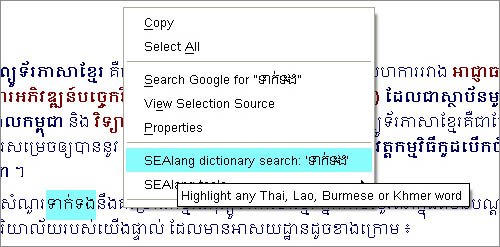
There's a new tool in beta over at sealang.net called Click SEAlang. It's a Firefox add-on that was developed by Roger Sperberg and Doug Cooper. I'm affiliated with SEAlang, but I've only been involved with the development of this tool as far as testing, so I'm just as much a user as anyone. And I think it's quite handy.

The idea is pretty simple. Highlight any word on a webpage and right-click it. Choose the Click SEAlang search option from the context menu. This pops open the Click SEAlang panel on the left side of the browser (or alternately on the bottom of the browser). If it's an English word you've selected, you can do a reverse-search in SEAlang's Thai, Khmer or Lao dictionaries. If you've selected a Thai, Khmer, or Lao word, it can tell by looking at the Unicode which language the word is and will look it up in the appropriate dictionary.

After you've installed the extension, the SEAlang bullseye logo sits in the bottom
corner of your browser window, as you can see the in the screenshot, along with other extensions you might have installed. The Click SEAlang panel opens automatically whenever you highlight and right-click search, but you can also use this icon to manually pop the panel open and closed.

Be sure to set your preferred reverse-search language in the settings. You can find that under the Tools menu in Firefox, and then selecting Add-ons, then clicking the Options button for the Click SEAlang extension. If you're like me, even when you're reading in English, you'll run across a word and say to yourself, "I wonder what the Thai word for that is..."

The answer's a click away.

[More screenshots available here.]