Commercial dictionaries often use their wordcount as a selling point. This was particularly true during the heyday of the "unabridged" English dictionaries, when publishers competed to claim the highest number of words. For one thing, no dictionary has ever been truly unabridged. It's just a marketing gimmick. For another thing, what constitutes a "word" itself is problematic--do you count entries? do you count senses? Some publishers certainly intentionally inflated and even fudged their counts. Unabridged dictionaries eventually boasted figures past the half-million mark. In 1961, Webster's ThirdNew International Dictionary broke with that trend, following strict guidelines about what words were and weren't suitable for inclusion. It nixed all proper nouns, for instance. While its 1934 predecessor, Webster's Second, had claimed 600,000 words, the Third only claimed 450,000. (Ironically, its publishers still chose to add Unabridged to the title in later printings. Goes to show how meaningful that word is.)
Obviously, wordcount isn't a good measure of dictionary quality. In Thai we don't see this as much. The notable exception that I've seen is Wit Thiengburanatham (วิทย์ เที่ยงบูรณธรรม), whose library-size Thai-English dictionary boasts on its front cover to contain more than 80,000 words. Anyone who has used this dictionary knows what a large percentage of these are flora and fauna names, which I would guess is what makes up most of the different. These words are certainly valuable to record, but it goes to show why having a huge count doesn't necessarily mean more words that will be useful to the average user. But even if wordcounts aren't a good gauge of overall quality, they can still be a (very rough) gauge of coverage.
In 2005, during the early days of the project that became my senior thesis, I wanted to know how RID stacked up. Believe it or not, in this computer age, I counted the entries. I had no digital texts I could use, and since I watched a lot of TV anyway, whenever I found myself with downtime I'd count away, doing each letter of the alphabet separately, periodically jotting the number down on the corner of the page so I wouldn't lose my count. I kept a table on the flyleaf. I did one pass to count headwords (e.g. ใจ) and another pass to count subheads (e.g. ใจดี). Oh yeah, and did I mention I did this for the 1950, 1982 and 1999 editions? I know, it's embarrassing to admit, like saying I translated Harry Potter into Klingon. But lest you should mourn for my social life, I was engaged when I started and married by the time I finished. My wife thought I was crazy. Still does, most of the time. I also wonder.
Nowadays, I have digital texts of RID82 and RID99 (although the latter has lots of missing entries). And though I could check my counts, I haven't. The percentage difference is sure to be small. Or maybe I'm just scared I'll discover that I don't know how to count as well as I thought I did.
1950
1982
1999
Headwords
15,720
19,526
20,448
Subheads
8,404
14,387
18,753
Total
24,124
33,913
39,201
Net Increase
9,789
5,288
% Increase
40.6%
15.6%
The curious can see letter-by-letter breakdowns in the spreadsheet I made at the time, which I've uploaded to Google Docs. (It also contains a partial count of Matichon.)
Its interesting to note that while there were significant gains in both headwords and subheads between RID50 and RID82, there were less than a thousand new headwords in RID99, but upwards of 5,000 subheads. The differences aren't just new words, though. There are lots of changes (large and small) to the definitions between editions, mostly in the direction of beefing them up and adding more senses. And even though the total number of heads and subheads in RID99 is less than half of what Dr. Wit's dictionary claims, this does not even begin to capture the number of senses in the dictionary, so it's difficult to compare the two.
In the end, though, it's clear RID isn't anywhere near a complete record of the Thai language. It's probably a nearly complete record of Standard Thai, that mythical creature that is taught to all and spoken by none. Actual Thai is much harder to put in a book, much harder even to define.
Contenders in the commercial sector like Matichon are helpful, because by taking the descriptive approach to lexicography, they're helping force the Royal Institute to come out of its prescriptive shell, as seen by last year's release of their Dictionary of New Words, Vol. 1 (พจนานุกรมคำใหม่ เล่ม ๑). That's a good thing, because unless they continue to adapt their methods, their dictionary will become obsolete. If they keep up the same pace of their last dictionary, the next edition of RID will be released in 2024. And if there are only a few thousand new words and compounds in it, people will wonder if the decades of work were worth the trouble.
[Note: See also in this series introduction, sorting, orthography, symbols, pronunciation guides, and word senses. Forthcoming: list of abbreviations.] We're nearing the end of my translations of the frontmatter from RID99 (พจนานุกรม ฉบับราชบัณฑิตยสถาน พ.ศ. ๒๕๔๒). Etymology's on the agenda today. The original Thai for this section is here. There is actually more to translate in the dead tree version of the RID99, including a synopsis of the history of RID. But the electronic text of that extra stuff isn't included in the web version, which makes it a little harder to work with. Maybe I'll get around to translating that in the future, though.
In this post I've tried something new: the blue text is direct quotes of full or partial entries from the dictionary, for easier scanning. Scattered individual Thai words are still black.
Part 6: Etymology
1. The origin of a word is given at the end of the entry for that word, as an abbreviation in parentheses e.g. สทึง [สะ-] น. แม่น้ำ, ใช้ว่า จทึง ฉทึง ชทึง ชรทึง สทิง หรือ สรทึง ก็มี. (ข. สทึง ว่า คลอง). or การะบุหนิง น. ดอกแก้ว. (ช).
2. Any word that is given as being from another language in fact does not correspond exactly with the source word, because the words from languages such as Pali, Sanskrit, or Khmer that are borrowed in Thai are usually either shortened, changed orthographically, or changed phonetically, e.g. ธมฺม (Pali) and ธรฺม (Sanskrit) correspond to Thai ธรรม; โปฺรส (Khmer) corresponds to Thai โปรด. In giving the etymology, sometimes the spelling in the original language is given as well, e.g. ธรรม has (ส. ธรฺม; ป. ธมฺม), or โปรด has (ข. โปฺรส), in order to compare the original spelling with the spelling used in Thai. For loanwords which are written very close to the original language, only the source language is given, e.g. กฏุก only gives (ป.), and ศิขร only gives (ส.). If a word is both Pali and Sanskrit, then both languages are given, e.g. รจนา has (ป., ส.). If a word is partially Pali and partially Sanskrit, then the original spellings of both Pali and Sanskrit are given, e.g. ปราโมทย์ gives (ส. ปฺรโมทฺย; ป. ปาโมชฺช). If the spelling is Pali, but is very similar to Sanskrit, e.g. หทัย, then it is given as (ป.; ส. หฺฤทย), or if the spelling is Sanskrit but very similar to Pali, e.g. สตัมภ์, then it is given as (ส. สฺตมฺภ, สฺตมฺพ; ป. ถมฺภ).
3. Any word for which the language of origin is uncertain, but is written similarly to another language, it is given is parentheses to compare with this language or that language, e.g. กำปั่น น. เรือเดินทะเลขนาดใหญ่ชนิดหนึ่ง... (เทียบมลายู หรือฮินดูสตานี ว่า capel).
4. Some archaic words are written one way, but nowadays the spelling has changed, in which case both the archaic and the modern spelling may be included, e.g. วงษ์ (โบ) น. วงศ์. วงศ- and วงศ์ [วงสะ-, วง] น. เชื้อสาย, เหล่ากอ, ตระกูล. (ส. วํศ; ป. วํส). Or only the modern spelling may have an entry, and the archaic spelling is given in parentheses at the end of the definition, e.g. กำสรวล [–สวน] (แบบ) ก. โศกเศร้า, คร่ำครวญ, ร้องไห้, เช่น ไทกำสรดสงโรธ ท้ยนสงโกจกำสรวลครวญไปพลาง. (ม. คำหลวง ทานกัณฑ์). (โบ กำสรวญ).
One of the key things I learned from this section is why sometimes RID gives the spelling of the original word, like (ข. โปฺรส), and why sometimes it just gives the language, like (ป., ส.). If no spelling of the source word is given, then (so RID claims) the Thai spelling maintains the original spelling. In other words, it's a transliteration from the source language, which is often the case with Pali and Sanskrit words.
By doing a simple analysis of the (very flawed) full online text of the dictionary, here's a count of Thai word origins from several languages: Pali: 5183 Sanskrit: 4838 English: 982 Khmer: 427 Chinese: 109 French: 23 Malay: 22
Mistakes in my counting aside, clearly this is a significant weakness of RID.
Point 3 notwithstanding, it often holds that if no connection is certain, no etymological info is given. The (เทียบ X) note is used just over 100 times. Even older but well-known loanwords, like the Thai numbers เอ็ด, ยี่ and สอง through เก้า, which were borrowed from Chinese, are implicitly claimed as Thai. This may have been acceptable 50+ years ago, when the conventional wisdom among Thai scholars was that Thai was a relative of Chinese, but it's hard to excuse nowadays.
In addition, to say there are only 400 words from Khmer in Thai is comical, and I'd be surprised if Malay has really had less of an influence than French--even in Bangkok. The English figure above can't be trusted at all, because RID doesn't have an automatic way to distinguish between words which are transliterations from English (e.g. โฮเต็ล) and words which are translated from English (e.g. โทรทัศน์). I'd have to go through and do a manual count to know that.
The number of Indic loans, at roughly 10,000 words, makes up 25% of the dictionary's total entries, which sounds reasonable. I'm sure that a relatively small number of these make up more than 25% of actual word usage in Thai based on frequency, however. It's also worth mentioning that many Indic words--or alternate versions of them--came into Thai by way of Khmer, which is ignored in RID.
All said, RID is a decent beginning source, if woefully incomplete. Mostly their analysis is simplistic, ignoring how and when a particular word came into Thai, as well as failing to give the meaning of the word in the original language.
Here's something nice and light today, since it's my birthday (if only for a few more minutes). I think an occasional musician profile will add some more cultural variety to the blog. The first one will be the rock band Silly Fools (ซิลลี่ ฟูลส์).
Silly Fools was the first Thai band I came to like, back in aught-two, mostly through sheer virtue of the band's ubiquity at the time. I think the first song I ever heard was the single วัดใจ from their album Juicy, which came out a few months before I arrived in Thailand for the first time. They're not my favorite Thai band, but I still enjoy listening to those singles I "grew up" to Thai pop culture with.
Another earlier track I like is คิดถึง, off their 2000 album Mint. I can only find one copy on YouTube, and embedding is disabled for it. So you can watch it on there, if you like.
Sadly, the band as I came to know it is effectively dead. The frontman for Silly Fools, Toe (โต), quit the band in 2006 for religious reasons. In an apparent international crossover attempt a la Shakira or Thailand's own Sek Loso, the band replaced Toe with Benjamin Tuffnell, a Korean-born American singer. The band's new material is now exclusively English. I don't know what they're doing about their back catalog, though, so it seems like a strange choice.
There's an ongoing brouhaha in Bangkok over the sign language word for the new Prime Minister, Samak Sundarawej. The new PM, who was officially voted in this past Monday, has complained that Thai sign language interpreters refer to him by touching their nose with a cupped hand. On Thai TV several channels show a little box translating their programs into sign language, particularly during news and talk shows. The man's a little sensitive about the size of his schnozz.
Pundits have been duking it out in the media for more than a week now. The interpreters say that the sign isn't new--they've been using this sign for Samak for a long time now. Samak was previously the governor of Bangkok from 2000-2003, and has been a prominent and controversial political figure since he led the anti-communist witch hunts of the 1970s, and used U.S. involvement in the Middle East to justify Bloody May in 1992. He's no stranger to being in the news.
Right now I'm sitting here watching a Thai news talk show, and they've got a whole panel of sign language interpreters and deaf Thais on to talk about this. They're pointing out that they make up signs for public figures based on prominent physical features. Samak's nose isn't being picked on (sorry, I couldn't resist).
Their explanation makes good sense to me. But known for his sharp tongue and thin skin, it stands to be seen when or if Samak will give up this fight. It's getting a lot of press worldwide, and making rounds on the "weird news" websites. Samak has inadvertently discovered that the Streisand effect applies to more than just the internet.
I wonder if he'll do anything about his nickname among the general Thai populace, 'rose-apple nose' ...
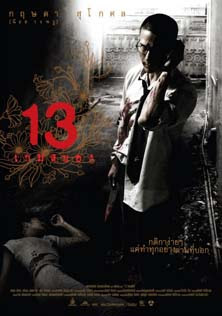
I didn't plan to write reviews for two films by the same director in a row, but that's how it happened. Since I probably won't make it to any movies in the theater any time soon, I'm stuck with what's available on DVD. Today I watched 13 เกมสยอง, a.k.a. 13 Beloved, and now also a.k.a. 13: Game of Death, which will be released on DVD in the U.S. next month.
That's right: ชูเกียรติ ศักดิ์วีรกูล (Chukiat Sakweerakul), director of รักแห่งสยาม (The Love of Siam), knows how to do more than make audiences giggle and swoon at teenage boys locking lips. 13 Beloved is an earlier directorial effort of his, from 2006. It never managed to capture my attention before, but based on Wise Kwai putting it in his top 10 Thai films, and because I thought รักแห่งสยาม had a lot of good points, I decided to check it out.
13 เกมสยอง tells the story of ภูชิต Puchit (Krissada Terrence), a band-instrument salesman who finds himself unable to keep up with increasing debt. His car is repossessed the same day an important sale goes sour, after which he finds himself out of a job with a 50,000 baht credit bill, and his mom calling to borrow money in a hurry. After getting a mysterious phone call, Puchit is forced by his dire circumstances into a sick game of 13 challenges, with the promise of a 100 million baht if he makes it to the end.
Now that I've seen two films of his, let me say this: Chukiat is another director I'm going to keep an eye on. I'm not in love with any of his work, but much like I said about รักแห่งสยาม, it's well above the average Thai film.
Amidst its more serious themes, 13 เกมสยอง has a running comic streak, and some truly hilarious moments that prove how laugh tracks and silly sound effects don't make comedy better. The scene with the "king" at the bus stop was inspired, and the scene with the Chinese family answering (er, not answering) the telephone cracked me up, too. Sometimes the film danced on the edge of the ubiquitous verbal slapstick brand of Thai comedy, but mostly it managed to restrain itself and keep me laughing. The scene in the police station is the main exception, going over the top with shouted insults like a pretty girl who doesn't know how much makeup is enough. The effects weren't great. When it was trying too hard to act like Saw or Hostel (bloated corpse, exposed brains), it took me out of the story. Fortunately the bulk of the film's effectiveness rests upon the shoulders of its protagonist. Krissada excellently portrays the desperation of a man in the shackles of debt. The main premise serves as an apt commentary on our potential for depravity, and how we propel ourselves further down that path with each thoughtless or cruel act we commit. Sometimes we are compelled by circumstances, but in the end we must take responsibility for our own actions. I thought the film showed this conflicted part of human nature well: the clash between ideal self and actual self, and reconciling the two when a lot is on the line. This is I would never go on a show like Fear Factor. My ideal self does not do things like eat animal innards or let himself get buried alive in cockroaches, and I don't want to put myself in a situation where my actual self would even question what I consider such a basic truth about myself. (Then again, I do enjoy the occasional baggie of fried crickets from a street vendor.) After loving the first half, the latter half was a disappointment. Half an hour in, I was saying to myself that this is a great premise worthy of a franchise. At 90 minutes, I began to wonder whether the premise could be rescued from the well it was floating in. It dragged on too long, with an unsatisfying twist. I haven't read the comic it's based on, so I can't compare the two. And I probably need to watch it again to catch the details of the ending, since I watched it without Thai subtitles. Sometimes things fly past me during inattentive moments. But the end felt squandered.
This film is not one I'd recommend to someone who had never seen a Thai movie. It suffers from some of the flaws of its numerous and terrible cousins of Thai cinema. Chukiat strikes me as a writer/director in need of a writing partner. If he can find someone to help write his screenplays, I think he could make a real masterpiece. Nonetheless, 13 เกมสยอง was good enough that I told a couple friends about it. And that says a lot.
There's some good discussion going on in the comments of yesterday's post about the new version of the online Royal Institute Dictionary, version 0.9.
There's another new thing I haven't commented on yet: the visitor counter. It sits there at the bottom of the page and tells you are ผู้เยี่ยมชม (visitor) number whatever. It debuted late the night of the 7th. The afternoon of the 8th it was around 1700. Right now, not quite two days after its debut, it's at 5336.
Of course, it's not counting visitor's at all. It's counting page views, and only of the main page, a very unsophisticated way of measuring traffic. It's a very 1990s-era counter, but at least it's not a cheesy odometer graphic. I'm responsible for a few dozen of those hits, and just now I refreshed about 10 times just to watch the number go up.
I hope they're keeping better track on their end of things. I want to tell them about free and excellent tools like Google Analytics. But then maybe traffic stats are considered "official information" unsuitable to trust foreigners with.
All said, they're getting thousands of page views per day. That's more than I can claim...
(This is a doctored photo. I couldn't help myself.)
As I surmised in last night's postwould happen, the online Royal Institute Dictionary got more than just a makeover today. Some of my previous gripes have been dealt with, either in today's update or else recently. Some of the changes:
You no longer get 40 "not found" messages along with your results.
Wildcard searching now works like it should, both for queries like ใจ* and *ใจ.
Even though large chunks of the text are still missing from the browsable text, you can now find words within those sections, such as ใส่ and ตาม, with the search function. Better than nothing.
There's also a new suggestion feature when your query returns no results. I discovered it by searching โหร- and it returned โหร. Turns out there's no entry with a hyphen. Suggestion is a great idea, but my first reaction is that most of the time no suggestion is given. I tested it with various words to see what it suggested.
ประเสิรฐ is a simple misspelling of ประเสริฐ, but no suggestion was made. สัญญาน returned สัญญา, but สัญญาณ would have been what I was looking for. เศษฐกิจ returned เศรษฐกิจ, as expected. สัญชาตญาน returned nothing. The correct spelling is สัญชาตญาณ. เหรียน returned เหียน, but I was hoping for เหรียญ.
A few more simple misspellings: โอกาศ returned nothing. ประกาส returned nothing. อากาส returned nothing. โลกาภิวัฒน์ returned nothing. ปรากฎ returned nothing. ประมาน returned nothing.
This feature isn't doing so well in my tests--all of which should have been very easy for it. There's a lot they could do to easily improve this feature. Like swap out similar consonants for each other, for example. If it did that it would pass pretty much all of my tests. It's probably using a fancy mathematical similarity rating, when a common sense approach to detecting spelling errors would be effective in most real-world scenarios. Another thing: suggestions are only given when no result is found for your query. Sometimes you can't find the right spelling for the word you want, but your misspellings coincide with other real words (like the time I just couldn't seem to find the right spelling of ปรอท [ปะหฺรอด]). It would be nice to see similarity suggestions as an option for all queries. There are other new "features", too. Beyond fixing the simple asterisk wildcard search, there are also plenty of unadvertised ways to search, if you're familiar with some basic regular expression notation. Some of this worked before, but I'll try to cover it in more detail later.
All said, this is a nice little upgrade for RID99 online.
[Update: The new search is now functional. Read about some of the changes here.]
I use the online version of the Royal Institute Dictionary nearly every day, so I tend to catch any changes to it quickly. Sometime between this afternoon and just now, RID online got a golden makeover:
Usually with the Royal Institute website, you can tell a change is coming because they break the website while they're changing it. And sure enough, you can't actually use the search feature on the main page of the dictionary right now, presumably while they're making whatever transition they're making. It returns a 404 page not found error, though you can still search individual letters. (Then again, it's 2 a.m. right now. But they don't understand the beauty of the internet if they think there aren't people like me who use their dictionary in the middle of the night.)
Also notice a new version number (version 0.9) down at the bottom of the page with the contact and copyright info:
Prior to now, no version number was given.
I've covered the new online version of RID99 (so-called by me because it corresponds to the 1999 print version) extensively since its release last June, particularly focusing on usability issues and other ways it's not meeting its electronic potential. [See here, here, here, and here.] I sent some feedback by email to the address given on the site shortly after the new dictionary showed up online, but got no reply and never saw my suggestions implemented. A couple of weeks ago, I had the chance to visit the Royal Institute, and while this wasn't the main purpose of the trip, I took the opportunity to pass on a list of issues that I had prepared and printed. I hoped it would be received in the spirit of constructive criticism that I intended.
I'm not going to go so far as to claim any direct connection between this site update and my suggestions (or my nagging, depending on how you look at it). But if this makeover on the site means we can expect improvements soon (like, in the morning, I hope), then at least I know they're still developing the online tool. It's gratifying to see it get better, regardless.
In fact, at least one of the issues that I originally wrote about has been fixed: even though the browsable full-text version of the dictionary is still missing large chunks from the letters ต and ส, you can now search words from the missing chunks and get results. This wasn't the case at first. Progress has been slow in coming, but it looks like we might be getting there.
I'll have a full report of any changes I can find after it's fully operational again. Stay tuned.
 Commercial dictionaries often use their wordcount as a selling point. This was particularly true during the heyday of the "unabridged" English dictionaries, when publishers competed to claim the highest number of words. For one thing, no dictionary has ever been truly unabridged. It's just a marketing gimmick. For another thing, what constitutes a "word" itself is problematic--do you count entries? do you count senses? Some publishers certainly intentionally inflated and even fudged their counts. Unabridged dictionaries eventually boasted figures past the half-million mark. In 1961, Webster's Third New International Dictionary broke with that trend, following strict guidelines about what words were and weren't suitable for inclusion. It nixed all proper nouns, for instance. While its 1934 predecessor, Webster's Second, had claimed 600,000 words, the Third only claimed 450,000. (Ironically, its publishers still chose to add Unabridged to the title in later printings. Goes to show how meaningful that word is.)
 Obviously, wordcount isn't a good measure of dictionary quality. In Thai we don't see this as much. The notable exception that I've seen is Wit Thiengburanatham (วิทย์ เที่ยงบูรณธรรม), whose library-size Thai-English dictionary boasts on its front cover to contain more than 80,000 words. Anyone who has used this dictionary knows what a large percentage of these are flora and fauna names, which I would guess is what makes up most of the different. These words are certainly valuable to record, but it goes to show why having a huge count doesn't necessarily mean more words that will be useful to the average user. But even if wordcounts aren't a good gauge of overall quality, they can still be a (very rough) gauge of coverage.
 In 2005, during the early days of the project that became my senior thesis, I wanted to know how RID stacked up. Believe it or not, in this computer age, I counted the entries. I had no digital texts I could use, and since I watched a lot of TV anyway, whenever I found myself with downtime I'd count away, doing each letter of the alphabet separately, periodically jotting the number down on the corner of the page so I wouldn't lose my count. I kept a table on the flyleaf. I did one pass to count headwords (e.g. ใจ) and another pass to count subheads (e.g. ใจดี). Oh yeah, and did I mention I did this for the 1950, 1982 and 1999 editions? I know, it's embarrassing to admit, like saying I translated Harry Potter into Klingon. But lest you should mourn for my social life, I was engaged when I started and married by the time I finished. My wife thought I was crazy. Still does, most of the time. I also wonder.